CHESSBOOKS.IN JOURNAL
The Back Rank Mate and How to Use It
The back-rank mate is the simplest checkmate in chess — and the one that decides an absurd number of amateur games. A castled king, its own pawns on the seventh rank, and one rook on the open file: game over, often in one move. Every player has been on both sides of it. This article makes sure you’re the one delivering it.
By the end you’ll know the pattern cold, the deflection tricks that make it work against defended rooks, and when — and when not — to make “luft” to avoid it.
The pattern
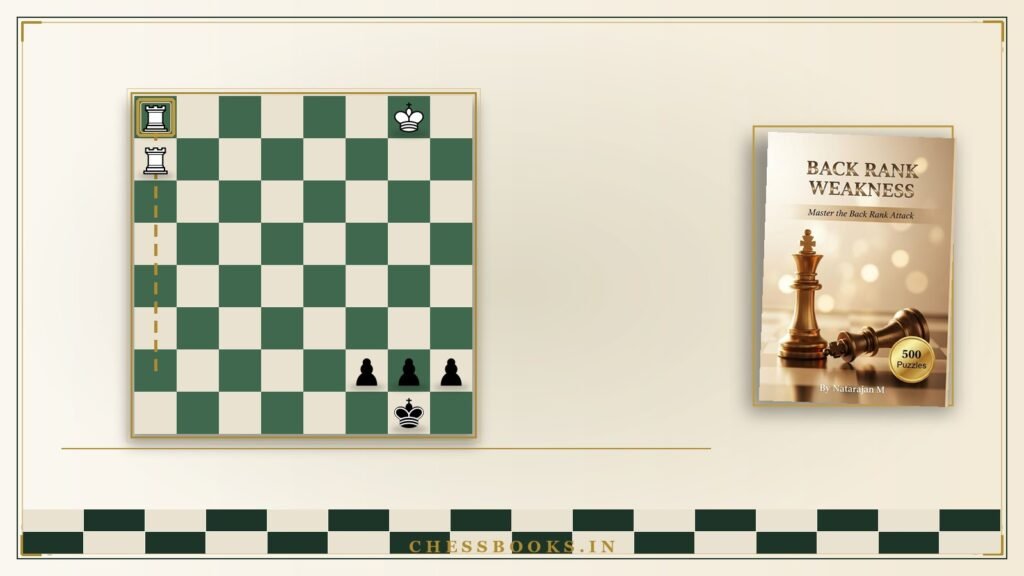
After castling kingside, the king sits on g1 or g8 behind pawns on f2/g2/h2 (or f7/g7/h7). Those pawns are its prison: the only escape squares are along the back rank. A rook or queen that reaches that rank mates — because every flight square is covered by the attacking piece itself.
1.Rd8#. The rook lands on the 8th rank; the king has no escape. The pawns that were meant to protect it sealed its fate.
Why beginners suffer it
Because they don’t move the pawns in front of the king. After castling, a natural “safe” move like 1…h6 or 1…g6 creates luft — an escape square for the king — but beginners often leave all three pawns on their starting squares for the whole game. Every open file pointing at the back rank is then a potential mate.
How to exploit it
Double rooks on the open file
Stack rooks on the open file and the mate threat is doubled: one rook checks, the other covers the defender. If the defender captures the first rook, the second mates.
Queen + rook combinations
The queen alone can often mate on the back rank; a rook behind it makes the threat unstoppable.
Deflection: remove the guard
If a black rook guards the back rank, deflect it first. Give up a rook to drag the defender off the rank, then mate with the queen — the classic “sacrifice on the back rank.”
Worked examples
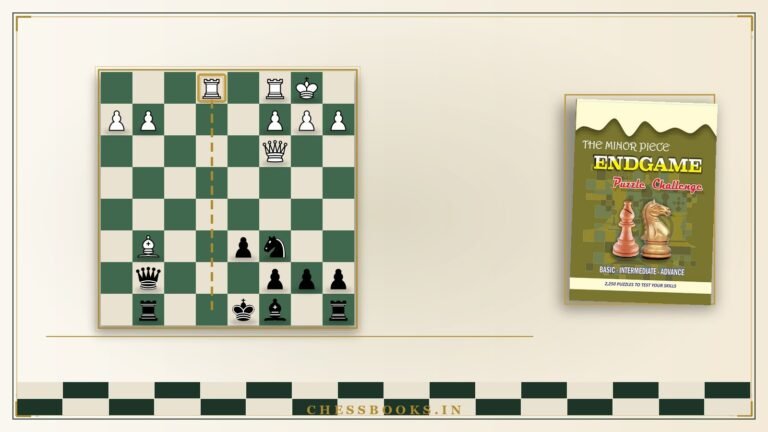
Example 1 — the double-rook mate. White to move, two rooks against a lone defender:
1.Rd8+ Rxd8 2.Qxd8#. The black rook is deflected off the back rank, and the queen finishes.
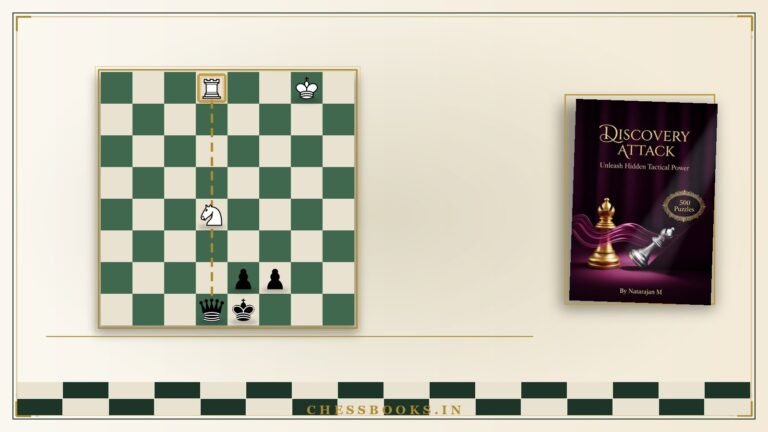
Example 2 — capture the guard directly. When the defender sits on the mating square itself:
1.Rxd8#. The rook captures the guard and mates with the same move.
How to defend: make luft — at the right time
Luft (German for “air”) is a pawn move in front of the castled king — h3 or g3 — that gives the king a flight square. The rule of thumb:
- Do it when the back rank is threatened — an enemy rook or queen on an open file pointing at your first rank.
- Don’t do it too early. h3/g3 weakens the kingside; an early luft gives attacking pieces hooks to grab.
Also: trade rooks. Fewer defenders of the 8th rank means fewer mating threats. And keep an eye on your own back rank in the endgame — the king’s escape is often a tempo too slow.
Common mistakes
- Making luft too early. h3 before any threat just weakens your king and gives the opponent a target.
- Missing that the rook is also pinned to the back rank. A rook that must stay on the 8th rank to defend is a rook that can’t move anywhere else.
- Forgetting the queen can mate alone. You don’t always need the rook — a queen landing on the back rank with support mates just as well.
- Deflecting with the wrong piece. The deflection sacrifice only works if the piece that mates is defended.
Five back-rank puzzles
White to move in each. Look for the open file, the trapped king, and the guard to remove. Drag or click a piece to play.
Puzzle 1 — Queen mates alone
Puzzle 2 — Deflect the guard
Puzzle 3 — Capture the guard
Puzzle 4 — Queen and king mate
Puzzle 5 — Rook and queen deflection
Exploit the 8th rank
The back-rank mate is one of the highest-return patterns you can train. Back Rank Weakness — Master the Back Rank Attack is 500 positions built around exactly this theme: delivering the mate, deflecting the guard, and creating the weakness. Ten minutes a day and you’ll never lose to your own back rank again.
Browse more chess tactics books, and see Pins and Skewers and Basic Checkmates Every Beginner Must Know for the patterns that surround it.