CHESSBOOKS.IN JOURNAL
Zugzwang, X-Ray and Fortress: Advanced Tactical Motifs
Fork, pin, skewer — these are the tactics every player learns. But the tactics that decide serious games belong to a second family: zugzwang, x-ray and fortress. They are rarer, subtler, and they win games that basic tactics cannot touch.
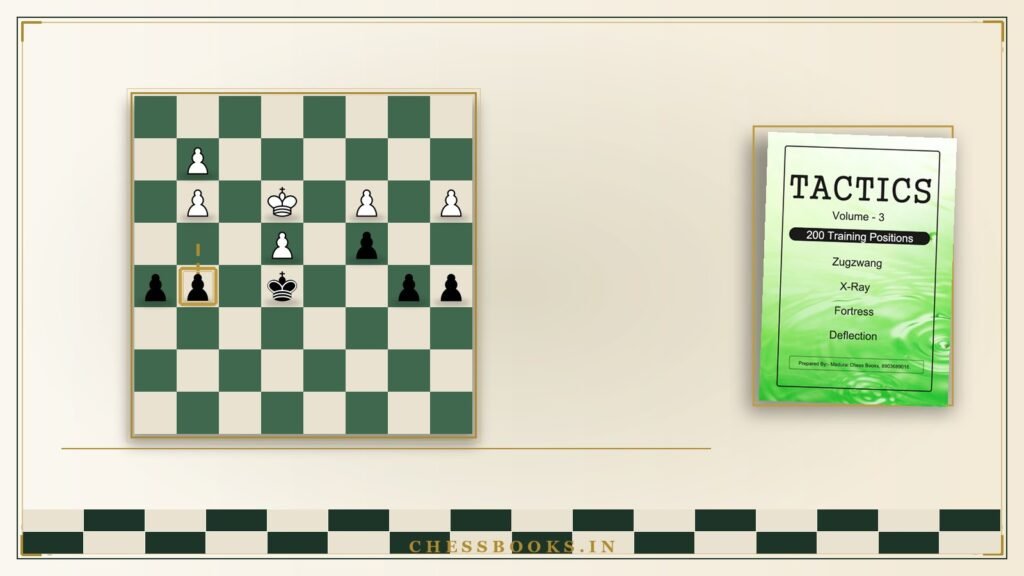
By the end of this article you will understand all three motifs and have four positions where the advanced idea is the whole point.
Zugzwang: the obligation to move
Zugzwang (German: “compulsion to move”) is the situation where having the move is a disadvantage. In normal positions, moving is good. In zugzwang, every legal move worsens your position, and the player who is forced to move must damage themselves.
Zugzwang is most common in endgames, where the king has few squares. The classic pattern: you threaten mate or a decisive win, and the defender’s only moves shuffle the king into a worse square — until one move loses directly. The attacker’s task is often to make a waiting move that hands the move over.
X-ray: attacking through a piece
The x-ray is a line attack that works through a piece. The defender sits in the way — but if it moves or is captured, the piece behind it is hit. The classic example is the queen or rook lined up against an enemy piece that cannot move because of the discovered threat behind it.
X-ray patterns are the bridge between pins and discovered attacks: the piece in the middle is not pinned to the king, but it cannot move because the target behind it is more valuable. Recognising the x-ray turns “why can’t I just move here?” into a winning idea.
Fortress: the drawn position
The fortress is the defensive cousin: a position where the side with less material cannot lose, because the defender controls the only squares that matter. The classic fortresses: the wrong-coloured bishop and the corner pawn, the rook’s pawn held by a bishop, or a king trapped in a box the attacker cannot enter.
Fortress recognition is a defensive skill that saves half-points — and an offensive skill: knowing the fortress means knowing not to head into it. When you are winning, the question is always: can I force a win, or am I walking into a fortress?
Common mistakes
- Forcing the win into a fortress. Before exchanging into an endgame, ask whether the remaining position is a fortress. If it is, find another path.
- Missing the waiting move. Zugzwang wins require patience. The move that changes nothing is often the move that wins everything.
- Not seeing x-ray threats. A piece “stuck” because of a hidden line is a piece you should be attacking.
- Confusing fortress and simple defence. A fortress is structural — the draw holds against any play. Check that first before trusting it.
Master the advanced motifs
The Tactics Vol 3 book is a full course on exactly these patterns — zugzwang, x-ray, fortress, deflection and the rest of the advanced motif family — 200 puzzles of the tactics that decide serious games.
Browse the exercise books, and continue the sequence with In-Between Moves: The Intermezzo — the other great “advanced” idea.