CHESSBOOKS.IN JOURNAL
The Caro-Kann: A Solid Repertoire Against 1.e4
Every player who faces 1.e4 eventually asks the same question: what do I play as Black that does not require memorising fifty sharp lines? The Caro-Kann is the classic answer. It gives up the centre willingly, builds a rock-solid pawn chain, and leaves White without the crushing attacks that punish careless Sicilians and Scandinavians.
By the end of this article you will know the Caro-Kann’s main lines, the two structures you will play in most games, and the plans that follow from each.
Why the Caro-Kann: solid by design
After 1.e4 c6, Black prepares 2…d5. The point: unlike in the French Defence, the light-squared bishop develops outside the pawn chain to f5 or g4. Black accepts a cramped but perfectly healthy position — no weaknesses, no trapped pieces, and a pawn structure that is famously difficult to attack.
This is the classical main line. White has more space and easier development; Black has a structure that is extremely hard to break down. Understanding this trade — space for solidity — is the entire opening.
Line 1: the classical 3.Nc3 dxe4
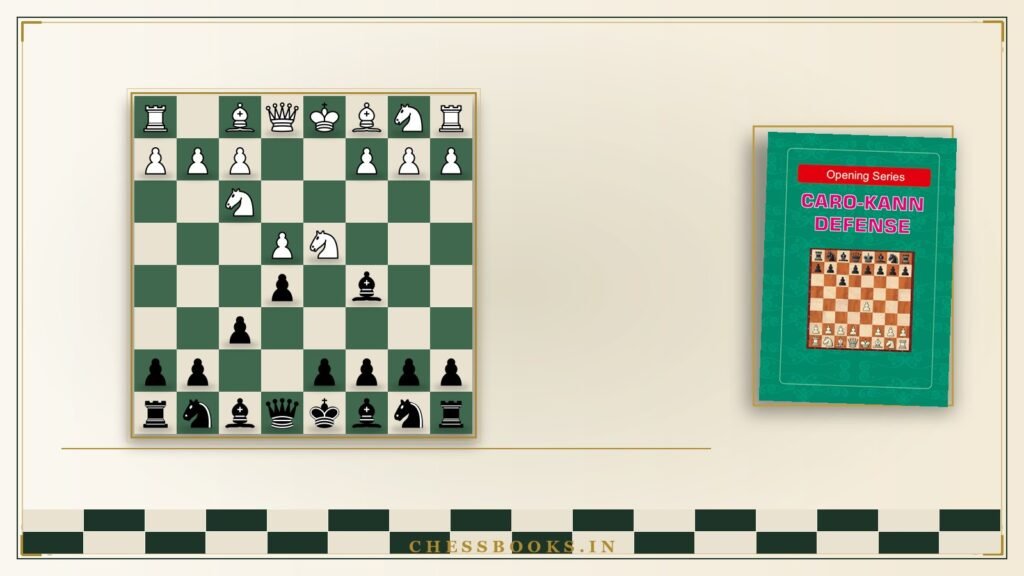
After 1.e4 c6 2.d4 d5 3.Nc3, Black’s most principled move is 3…dxe4 4.Nxe4. From here the main battle is over the f5-square:
- 4…Bf5 — the most natural, developing the bishop outside the chain.
- 4…Nf6 — fighting for the centre immediately. White usually plays 5.Nxf6+, giving Black doubled pawns but also a second bishop pair… wait — no: after 5.Nxf6+ gxf6 Black has doubled f-pawns but an open g-file and the bishop pair. The doubled pawns are not a weakness here because they control the e-file centre.
The position after 5.Nxf6+ gxf6 is the “isolated-pawn” Caro structure that appears in thousands of games. Black’s plan: develop normally, play …e6, …Be7, …O-O, and attack down the g-file. White’s plan: control the centre with c3-d4 and target the doubled f-pawns.
Line 2: the Advance variation
Against the Advance variation (1.e4 c6 2.d4 d5 3.e5), Black’s response is the same idea that works against every e5 advance: 3…Bf5 immediately, before White can play f4 and g4.
In the Advance, White has more space but the pawn chain gives Black a clear plan: attack the base of the chain with …c5 and later …f6, while the bishop on f5 is already developed and active. This is a perfect example of the French Defence idea — but with the bishop outside the chain, which is the Caro-Kann’s key advantage.
Common mistakes
- Developing the bishop to g4 instead of f5. In the Caro-Kann, …Bg4 invites Bf3 or h3 with tempo. The whole point of the opening is …Bf5.
- Playing …e6 too early. If you block the bishop’s diagonal with …e6 before developing the c8-bishop, you have played a French Defence without the French’s compensations.
- Forgetting the …c5 break. In the classical structure, Black’s freeing move is …c5. If you never play it, White’s centre stands forever.
- Grabbing the bishop pair mindlessly. After 5.Nxf6+ gxf6, remember the g-file is now YOUR file — rooks belong there.
Where to go from here
The Opening Series: Caro-Kann walks through every main White system — classical, advance, exchange, and the tricky 3.e5 sidelines — with the plans for Black. It is the same material as this article, with every branch covered in order of how often you will meet it.
Explore the full Opening Series, and pair the Caro-Kann with The French Defense: Fighting the Pawn Chain — together they give you a complete, solid answer to 1.e4.