CHESSBOOKS.IN JOURNAL
Pins and Skewers Explained
Pins and skewers are the tactics that feel like magic when you first see them: a piece that can’t move, or a piece that must move and lose what’s behind it. They’re also the tactics most improvers know by name but rarely find in their own games.
By the end of this article you’ll know the difference between a pin and a skewer, the three ways a pin wins, and how to create — and escape — both.
Pin vs skewer: the direction rule
Both tactics work along a line — a rank, file or diagonal — with three pieces: an attacker, a target, and something valuable behind the target.
- Pin: the target in front can’t move (or can’t move usefully) because moving exposes what’s behind. The back piece is the one that matters.
- Skewer: the piece in front must move away from the attack — and what’s behind it gets hit. The front piece is the one that suffers.
The memory rule: a pin stops the front piece; a skewer punishes it for moving.
Absolute vs relative pins
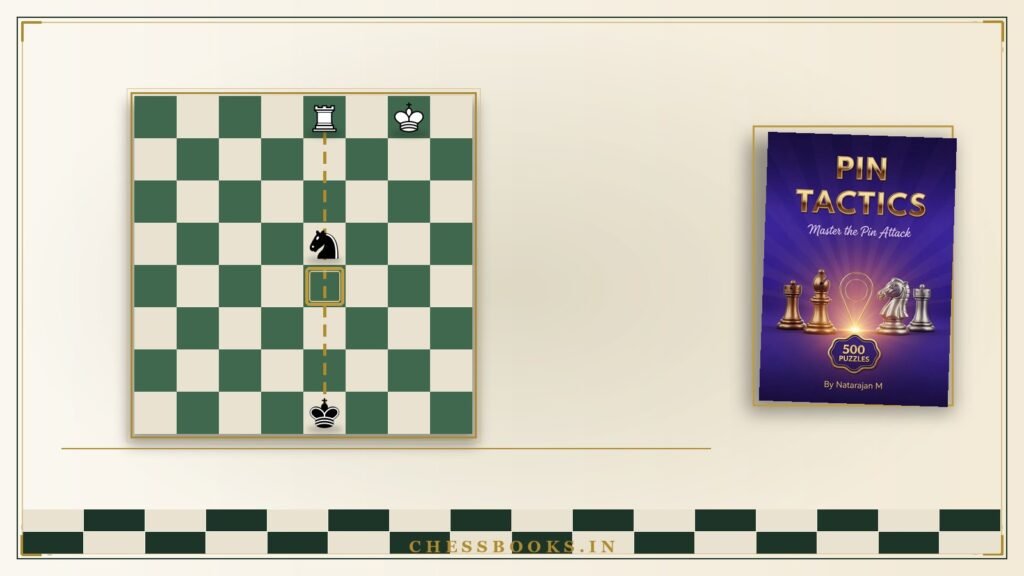
An absolute pin is a pin to the king: the pinned piece legally cannot move at all, because moving would expose the king to check. A relative pin is a pin to anything else — usually a queen or rook. The pinned piece can move, but doing so loses something more valuable.
The three ways a pin wins
- The pinned piece falls. You attack the pinned piece once more than it can be defended — or simply capture it when the defender can’t recapture (the king can’t take back if the pinned piece stood two squares away).
- The defender is overloaded. A pinned piece is frozen as a defender. While it’s pinned, the piece it defends becomes undefended — and you attack that instead.
- The attack repeats. Against a relative pin, you can win by threatening the pinned piece again and again until the owner runs out of defences.
Skewers: files, ranks and diagonals
Skewers are pins in reverse — the most famous kind attacks the king and wins a big piece behind it. Rooks and queens skewer along files and ranks; bishops and queens skewer along diagonals. The classic pattern: give check along a line, the king steps off it, and the piece behind is lost.
How to create pins and skewers
You create them by opening lines and by luring pieces onto the same line as something valuable. A pawn move that opens a file for your rook, or a sacrifice that drags a defender onto a diagonal with its own queen — these are the moves that set up pins and skewers. Look for any line where two enemy pieces stand on the same rank, file or diagonal, with nothing between them.
Escaping pins and skewers
If you’re pinned, your options are: interpose (block the line with another piece, when the pin is only to a queen or rook), counterattack (move the pinned piece with a bigger threat of your own — legal only against a relative pin), or break the line (capture the pinner, if it’s not defended). Against a skewer, the front piece should move to its best square — the back piece is usually lost, so minimise the damage.
Common mistakes
- Treating a relative pin as absolute. A piece pinned to a queen can still move if the move comes with an even bigger threat.
- Forgetting the pinned piece still defends. A pinned knight on f6 still guards h5 and e4 — it’s frozen, not dead.
- Pinning a piece that can simply move out with threat. If the pinned piece’s escape is a strong move, your pin was just a tempo giveaway.
- Grabbing the pinner. Before you capture a pinned piece, check whether the recapture is legal — the king can’t take back, but a queen can.
Five pin and skewer exercises
Answer
1.Bxc6+! The knight was pinned to the king (it couldn’t move off the b5–e8 diagonal) and now falls. The king can’t recapture from e8. When a pinned piece is attacked and can’t be defended, take it.
Answer
1.Bxf6! The knight is pinned to the queen. If 1…Qxf6, then 2.Nxf6+ wins the queen for a bishop. The pin stopped the knight from moving; the second attacker (Ne4) turned the pin into a win.
Answer
1.Rg8+! Check along the 8th rank. The king must move (f8 is covered), and then 2.Rgxd8 wins the rook — the rook on d1 covers the recapture. King first, rook second — the classic skewer.
Answer
1.Qg8+! Same idea with the queen: the king steps off the line, and 2.Qxd8+ collects the rook — the rook on d1 covers the recapture.
Answer
1.Bxc6+! The knight on c6 blocked the bishop’s line to the king. Now it’s gone, the king is in check, and it can’t recapture (Nd4 defends c6). The king moves — and 2.Bxe8 wins the queen that stood behind it.
500 pin puzzles to make the pattern instinctive
Pins and skewers are patterns — and patterns are trained by repetition. Pin Tactics — Master the Pin Attack gives you 500 positions built around the pin, the skewer and the lines that create them, so the pattern becomes instinctive instead of theoretical.
Browse more chess tactics books, and next in this series: the fork — and later, the back-rank mate, the pin’s favourite victim.