CHESSBOOKS.IN JOURNAL
Discovered Attacks and Discovered Checks
Every chess tactic has a moment where the board “opens up.” The discovered attack is the purest version of that: one piece moves, and the piece behind it suddenly attacks something the enemy thought was safe. It wins games at every level because it is invisible until the moment it happens.
By the end of this article you’ll understand the mechanism, the three flavours (discovered attack, discovered check, double check), their power ranking, and how to spot the pattern in your own games — with interactive boards to practise on.
The mechanism
A discovered attack needs a line with two of your pieces on it: a front piece and a back piece. The front piece blocks the back piece’s attack. When the front piece moves — ideally with a threat of its own — the back piece’s attack is “discovered.”
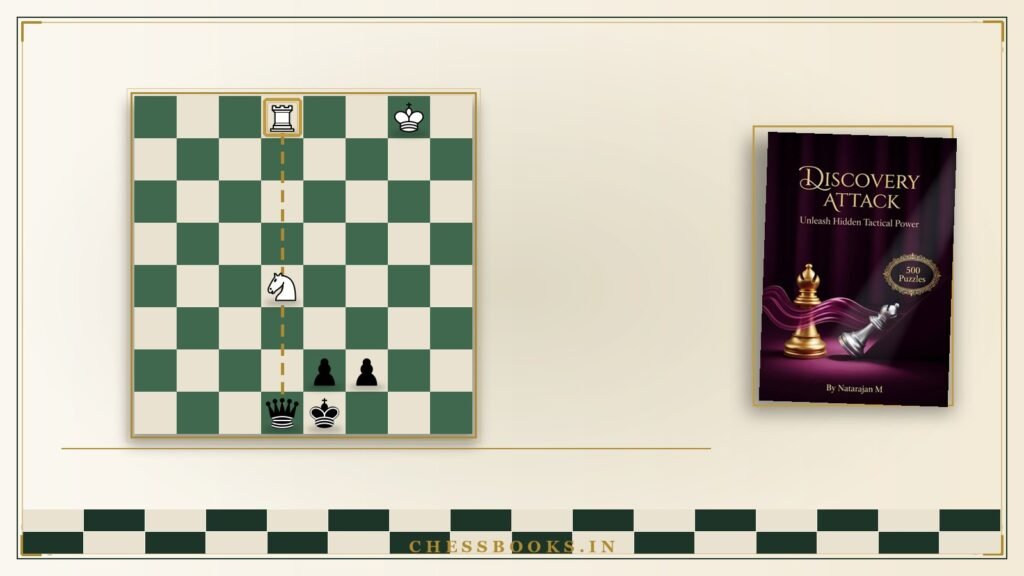
Here the knight on d5 blocks the rook on d1. When the knight moves with gain, the rook will attack the black rook on d8 — that’s the discovery.
Three flavours, three levels of danger
1. Discovered attack (danger: material)
The front piece moves, the back piece attacks a target. The defender can usually save the target — unless the front piece’s move also creates a threat, in which case something falls.
2. Discovered check (danger: material, forced)
The front piece moves with check. Now the opponent must deal with the check first — and can’t also save the piece the back piece is attacking. Discovered checks win material almost by definition.
3. Double check (danger: checkmate)
Both the moving front piece and the revealed back piece give check at the same time. Against a double check, the king must move — no block, no capture can stop both checks. Double checks are how mating nets get woven.
Why double check is the most dangerous
Against an ordinary check, the defender has three options: move the king, block, or capture the checking piece. Against a double check, only one works: move the king. If the king has no safe square, the double check is checkmate. Here’s one:
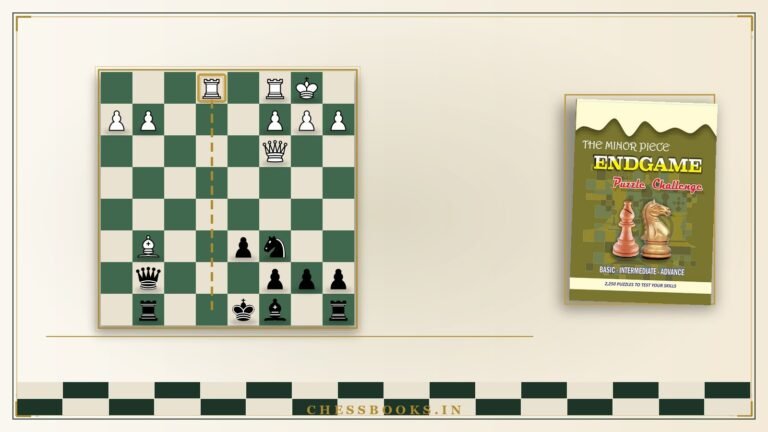
1.Nf7#. The knight gives check on h8 while revealing the rook on h1 checking along the h-file. Black’s king must move — and has no safe square. That’s the power of a double check.
Worked examples
Example 1 — discovered check wins the queen.
1.Nc7+! The knight gives check on the king while the rook on d1 attacks the queen on d8. Black must answer the check; the queen falls next move.
Example 2 — double-check mating net. The diagram above: 1.Nf7#. Notice the knight does double duty — it checks the king and opens the rook’s line at the same time.
How to spot the pattern
Ask two questions on every move:
- Where are two of my pieces on one line? A rook behind a knight, a queen behind a bishop — find the blocked line.
- Can the front piece move with gain? A check, a capture, or a threat. If yes, the back piece’s target is in trouble.
Defensively, the mirror question: what is my opponent’s front piece about to reveal? Players who always look for blocked lines stop blundering to this pattern.
Common mistakes
- Moving the front piece to a square it gets captured on. The discovery only works if the front piece lands somewhere safe or with a bigger threat.
- Missing that the revealed target is defended. A discovered attack on a defended piece wins nothing.
- Wasting a double check on a trivial gain. If the king has a safe square, the double check is just a check — make sure it actually wins.
- Forgetting the front piece itself is also a threat. The two threats together are what make the tactic work.
Five discovered-attack puzzles
White to move. Find the front piece that moves with gain, and calculate what the revealed piece attacks. Drag or click a piece to play.
Puzzle 1 — Discovered check wins a rook
Puzzle 2 — Discovered check wins the queen
Puzzle 3 — Double check mate
Puzzle 4 — Discovered check, different angle
Puzzle 5 — Discovery plus a fork of the rook
Uncover the hidden attack
Patterns like these become instinct with repetition. The Discovery Attack — 500 Chess Tactical Puzzles is built entirely around this mechanism: 500 discovered attacks and discovered checks, from simple to sharp, so the pattern shows up in your games without you hunting for it.
Browse more chess tactics books, and pair this with The Fork and Pins and Skewers — the three patterns that decide most amateur games.