CHESSBOOKS.IN JOURNAL
The London System in 15 Minutes
Every club player has asked the same question: what do I play as White that doesn’t require memorising a different opening against every defence? The London System is the most practical answer. One setup, one set of plans, and it works against anything Black plays after 1.d4.
By the end of these 15 minutes you will know the London setup by heart, the three plans that follow from it, the responses that actually test it, and a short model game showing the whole idea.
Why the London: one setup, any reply
After 1.d4, Black has dozens of respectable defences: d5, Nf6, c5, e6, g6, f5, Nc6… Instead of learning a separate line for each, the London player plays the same developing moves no matter what: the pawn goes to d4, the dark-squared bishop to f4, then e3, Nf3, c3, Bd3, Nbd2 and castling. Black’s choice of defence changes the plan, but never the setup.
That’s the real selling point — not that the London is unbeatable, but that your opening knowledge stays small while your middlegame knowledge grows.
The setup, move by move
The backbone of the London, in order:
- 1.d4 — claim the centre.
- 2.Bf4 — the London bishop, developed before the knights.
- 3.e3 — solid, keeps the dark-squared bishop’s diagonal open.
- 4.Nf3 — natural development.
- 5.c3 — prepares the e4 break and supports the centre.
- 6.Bd3 — points at the kingside.
- 7.Nbd2 — the queen stays home; the knight goes to d2, not c3.
- 8.O-O — king safe, rooks connected.
Notice what’s not there: no early Nb1-c3, no queen sortie, no risk. The knights go to f3 and d2, the bishop to f4, and the pawns stay flexible.
The typical plans
Plan A: the e4 break
With pawns on d4 and c3, the move e4 is the London’s central lever. If Black has played …d5, you push e4 to open the centre on your terms. If Black can’t keep the tension, you get a mobile pawn centre.
Plan B: kingside pressure
With Bd3 and Bf4 aiming at the kingside and a knight on f3, a later Qe2, h3 and g4-style expansion (or a quick Ng5 after Black castles short) puts Black’s king under pressure.
Plan C: queenside pressure
When Black castles queenside or the centre closes, the London’s pawns on c3/d4 support a b4-b5 advance with Nb3 or Qb3 ideas against c6/c7.
The key responses to know
…c5 — the main test
Black attacks the d4-pawn and challenges the whole setup. The London answer is simple: c3, keeping d4 defended, then develop normally. Black has spent a move on c5; you have spent a move on c3. Both sides continue.
Here the e4 break is the natural next step — after c3, e4 fights for the centre, and Black must decide whether to take or let the pawns advance.
…Nh5 — harassing the bishop
Black hits the London bishop with the knight. Retreat it to g3 (or g5 where the position allows) — the bishop has done its job on f4 and the tempo “wasted” is real but harmless. Bg3 keeps the pressure on e5.
…f6 ideas
Black sometimes plays …f6 to blunt Bf4 and prepare …e5. Don’t panic: e3-e4 still opens the centre, and a black pawn on f6 weakens the e6-square and the kingside dark squares.
A mini model game
1.d4 d5 2.Bf4 Nf6 3.e3 e6 4.Nf3 Be7 5.Bd3 O-O 6.c3 Nbd7 7.Nbd2 c5 8.O-O b6 9.e4 — the e4 break lands. Black’s pawns on d5 and c5 are under fire. If 9…dxe4 10.Nxe4 Nxe4 11.Bxe4, White has a comfortable centre and the bishops eye the kingside. The London has delivered a playable middlegame with zero theory memorised.
Common mistakes
- Playing Bf4 too early against …c5 — or too passively. After …c5, keep the bishop active; don’t retreat it to a passive square without reason.
- Forgetting the e4 break. The London is not a passive system. If you never play e4, Black gets everything they want.
- Overextending on the kingside. h4-h5-g4-g5 before development is complete just weakens your own king.
- Autopiloting against …Nh5. Look before you retreat — sometimes the bishop can stay active with Bg5.
Three positions to set up and play
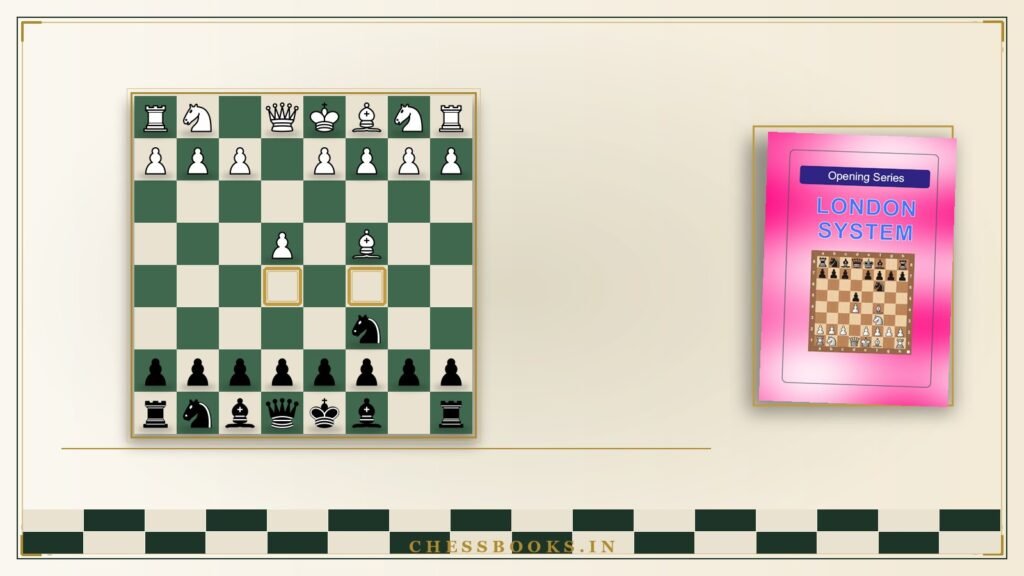
Set up the three diagrams above on a board and play them out: first the plain setup, then the …c5 line, then the e4-break position. For each, ask: where is Black weakest, and what is my next move? Ten minutes of this is worth more than an hour of memorising lines.
Build your London repertoire
The Opening Series: London System — Building a Solid Repertoire walks through every main Black response with the plans you need, in order of how often you’ll meet them. It’s the same material as this article — just with every branch covered.
Explore the full Opening Series, and see The Fork: Chess’s Most Common Tactic for the tactics that decide the middlegames your new opening produces.