CHESSBOOKS.IN JOURNAL
Chess Visualization: What It Is and How to Train It
You calculate a promising line, play it with confidence — and three moves later realise you lost a piece two moves back. That’s not a calculation error. That’s a visualization error: you couldn’t hold the moving position in your head, so your “calculation” was built on a board that no longer existed.
By the end of this article you’ll understand what chess visualization actually is, why it’s the skill underneath every calculation, and how to train it deliberately — without a board, without an engine, ten minutes a day.
What visualization is (and isn’t)
Visualization is the ability to hold a chess position in your mind and update it as pieces move. It’s not magic and it’s not memory tricks. It’s a trainable skill with two components:
- Holding the position — keeping the coordinates of the pieces stable in your head.
- Updating it — correctly moving one piece, then the next, and re-seeing the whole board.
Calculation is what you do with the visualized board. If the board is wrong, the calculation is fiction. Most blunders are vision failures, not knowledge gaps.
Why you can’t calculate what you can’t see
Think of the last time you miscalculated. Did you miss the line because you didn’t know the tactic — or because you stopped seeing the board clearly two moves in? For most improvers it’s the second. The position “went blurry,” pieces floated, and the line you committed to was never real. Training visualization raises the depth at which the board stays sharp.
The training method: solve without moving
Here is the method that works:
- Take a position and do NOT touch the pieces. Not the mouse, not the physical pieces. Your board is your head.
- Say the moves out loud in coordinates. “knight f3 to e5, bishop c8 to g4” — naming squares keeps the image anchored.
- Start at 2-3 moves and grow. Visualize White’s move, Black’s reply, White’s second move. When you can hold that cleanly, go deeper.
- Verify at the end. Recreate the final position, then check it against the real board. The gap between what you saw and what’s there is what you’re training.
A worked sequence
From the starting position of this famous tactical shot:
Close your eyes. 1.Bxf7+ — the bishop takes the f7 pawn with check; the king must respond. 1…Kxf7 — the king captures the bishop on f7. 2.Nxe5+ — the knight forks the king and queen on e5 with check. Now open your eyes and verify: black king on f7, white knight on e5, black queen still on d8. If you saw that whole sequence, you just visualized three moves.
Visualization vs blindfold chess
Visualization training is the warm-up; blindfold chess is the full workout. Blindfold play demands holding every piece and the whole game state for long stretches — far harder than a three-move sequence. That’s why the training ladder runs: coordinates → short sequences → longer sequences → positions → full blindfold games. The Blindfold Chess Training Level 1 books start where visualization ends.
Common mistakes
- Rushing to long lines. A 15-move calculation built on a blurry 3-move board is worse than a sharp 3-move one. Depth is earned.
- Using the mouse or board as a crutch. If you slide pieces to “check,” you’re not training visualization.
- Mixing up coordinates. d4 and d5 are different worlds. Say the squares aloud until the confusion dies.
- Skipping the verification step. The gap between your mental board and the real one is the whole signal. Measure it every time.
Three visualization sequences
For each: set the position, look once, then play the full line from memory on the interactive board. No peeking mid-line. Drag or click a piece.
Sequence 1 — Three-move tactical shot
Sequence 2 — Back-rank deflection
Sequence 3 — Two captures, then the check
Start Volume 1 today
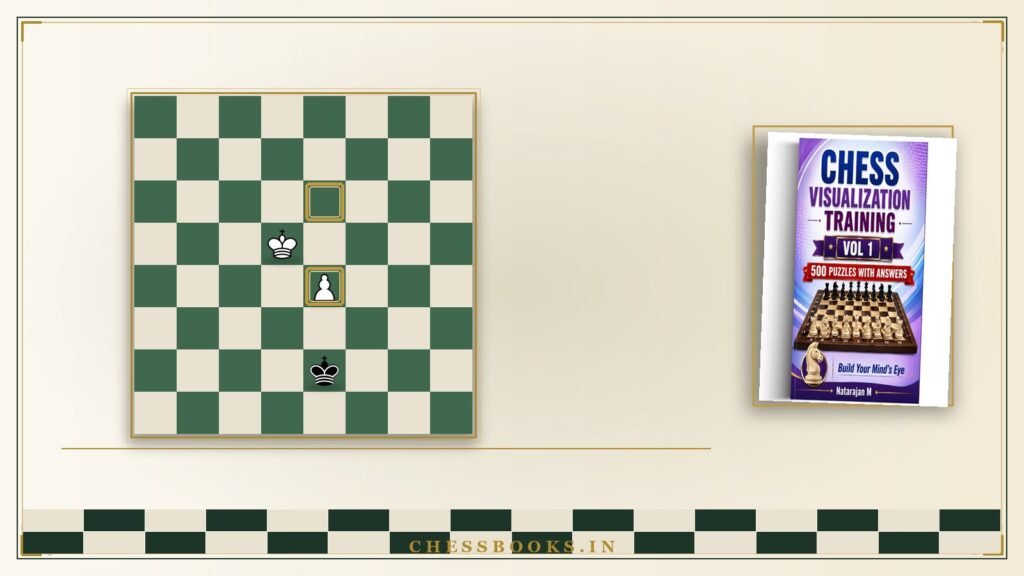
Structured visualization training removes the guesswork from practice. Chess Visualization Training — Volume 1 gives you 500 diagram-based puzzles designed exactly for this method: set the position, visualize, verify. Fifteen minutes a day, and the board in your head stays sharp one move deeper every month.
Explore the visualization training series, and read How to Solve Chess Puzzles the Right Way for the method that turns clear vision into good moves.