

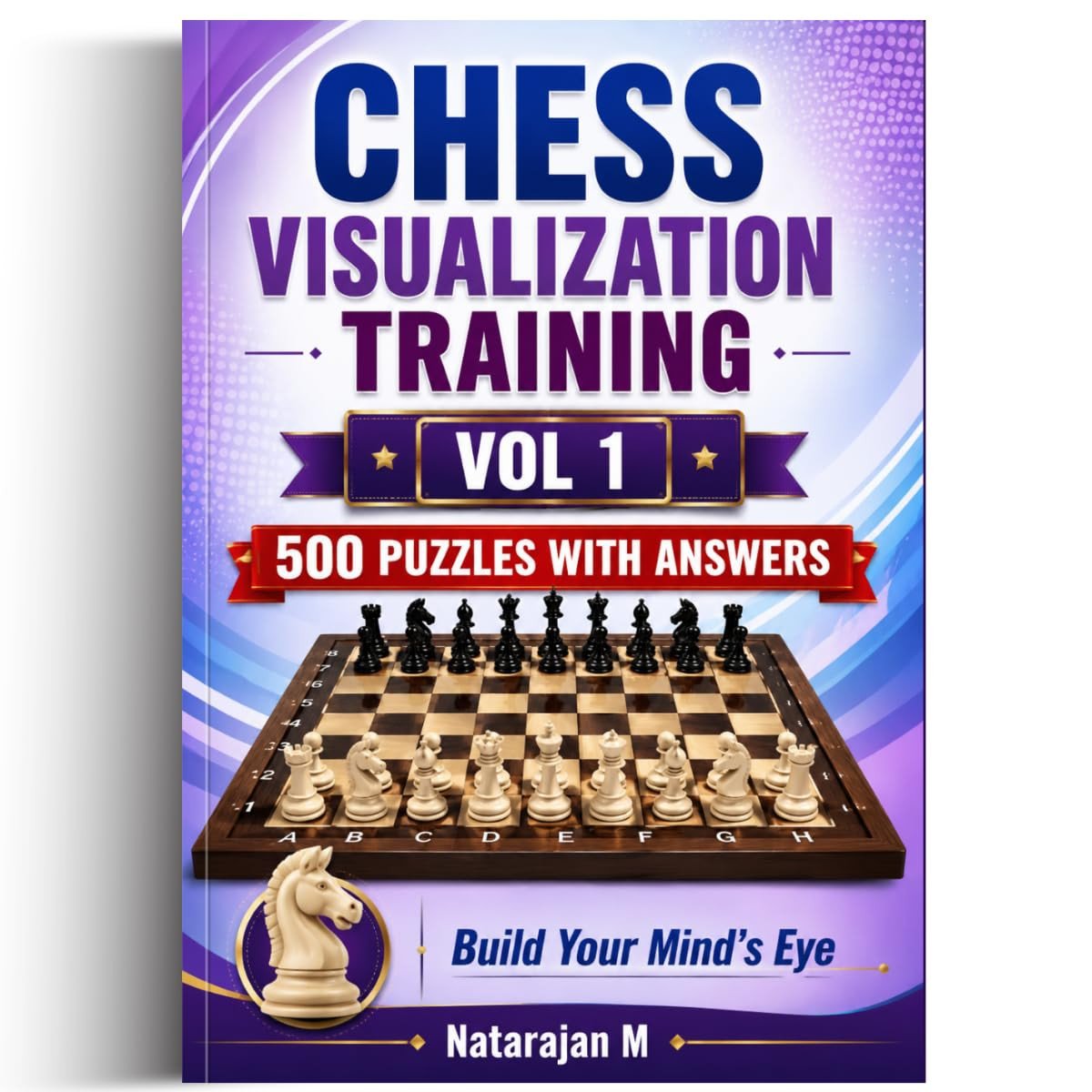
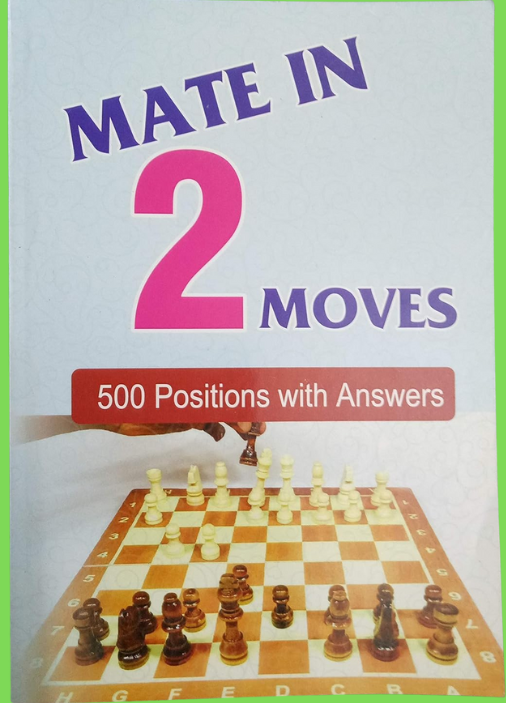
Chess Visualization Training - Volume 1 - 500 Chess Puzzles | Visualize 2 to 3 transition moves in your mind
MRP inclusive of all taxes
In stock — ready to ship
Chess Visualization Training — Volume 1: Easy Two-Move Sequences is a diagram-based workbook that systematically trains your mind's eye to hold, update, and read a chessboard after a short sequence of moves. Unlike the Blindfold Chess Training series (which removes the diagram entirely), this Visualization series starts with a printed board diagram, then asks you to play 2 to 3 transition moves in your head before solving the tactical puzzle. It is the perfect entry point for visual learners who want to build calculation depth gradually.
999 in stock
Description
What happens on the chessboard two moves from now? If you cannot see it clearly in your mind’s eye, you will keep making the same costly mistakes. This book teaches you to see the future board — one move at a time.
Here is a scenario every chess player knows: you are sitting at the board, thinking about your next move, and you calculate a promising idea. “If I play this, and my opponent responds with that, then I can play…” But when you try to see the position after those two moves, the board in your mind is foggy. You are not sure where the pawn ended up after the exchange. You forgot that the bishop’s diagonal opened. You missed that the rook is now hanging. So you play a different, “safer” move — and miss a winning combination. The problem is not your tactical knowledge. The problem is that your mind’s eye cannot hold the board clearly after even a short sequence of moves.
Chess Visualization Training — Volume 1: Easy Two-Move Sequences is a diagram-based workbook that systematically trains your mind’s eye to hold, update, and read a chessboard after a short sequence of moves. Unlike the Blindfold Chess Training series (which removes the diagram entirely), this Visualization series starts with a printed board diagram, then asks you to play 2 to 3 transition moves in your head before solving the tactical puzzle. It is the perfect entry point for visual learners who want to build calculation depth gradually.
How Does the Unique Training Method Work?
- Study the Printed Diagram: Each puzzle page features a high-quality, grayscale chess board diagram showing the starting position. Take as long as you need to absorb the position — identify all the pieces, the pawn structure, and the key features of the position.
- Read the Transition Moves: Below the diagram, you will find a short sequence of 2 to 3 moves printed in standard algebraic notation (e.g., 1. Nf3 d5 2. e4). These are the “transition moves” — moves that have been played before the tactical puzzle begins.
- Visualize the New Position: Play these 2 to 3 moves entirely in your head. Do NOT use a physical board or move the pieces on screen. Update the positions of all pieces in your mind’s eye — track captures, pawn advances, and piece movements. The position you see in your head after playing the transition moves is the real puzzle position.
- Solve the Tactic: From your visualized position, find the winning continuation — typically a 1 to 2 move tactical solution (a checkmate, a fork, a winning capture, or a skewer). Write your answer down in the space provided.
- Verify with the Solutions Page: Turn to the back of the book, where you will find step-by-step solutions in standard algebraic notation and (where needed) additional diagram verification. Confirm that your mental image was correct and that your tactical answer is right.
What You Will Find Inside Volume 1:
- 500 Carefully Selected Puzzles: Each position is curated from real master-level games, chosen specifically because the tactical solution depends on correctly visualizing a short move sequence — not just recognizing a static pattern.
- Grayscale Printed Board Diagrams: High-quality, clear board diagrams on every puzzle page give you a concrete starting point, making this series more accessible than the coordinate-only Blindfold series.
- Short, Manageable Transition Sequences (2–3 Plies): You only need to play 2 to 3 half-moves in your head — just enough to push your visualization without overwhelming it. This is the ideal starting depth for beginners.
- Simple Tactical Solutions (1–2 Moves): Once you have visualized the transition, the winning move is a clear, forcing tactic — a checkmate, a knight fork, a discovered check, or a winning capture. No ambiguous positional answers.
- “Turn to Move” Badge: Each puzzle features a clear badge indicating which side plays the solution move. This eliminates the confusion that plagues many puzzle books about whose turn it is after the transition sequence.
- Step-by-Step Solutions in Standard Notation: The answers section uses sequential algebraic notation, so you can follow the complete move order from the diagram through the transition to the solution.
- Write-In Answer Spaces: Dedicated space on each puzzle page to record your answer, reinforcing active learning.
- Clean, Professional Print Quality: Optimised grayscale printing, generous margins, and a clean layout designed for distraction-free study.
Skills You Will Build:
- Mental Board Updating: The core skill this book develops. You will learn to take a known position and accurately update it in your mind after a short sequence of moves — the exact process you use when calculating during a game.
- Capture and Exchange Tracking: When a piece captures another, many players’ mental image “glitches” — they lose track of which piece landed on which square. This book specifically trains you to track captures accurately.
- Post-Move Threat Detection: After visualizing the transition moves, you must immediately scan the new position for tactical opportunities. This builds the habit of reassessing the board after every move — a critical skill for over-the-board play.
- Sequential Thinking Discipline: By forcing you to process moves in order (study diagram → play transitions → solve tactic), this book builds the structured thinking process that prevents impulsive, calculation-free moves.
Who Is This Book For?
- Beginner to Intermediate Players: You know the rules, you have played some games, and you want to start calculating ahead with real accuracy. This is your ideal starting workbook.
- Visual Learners Who Find the Blindfold Series Too Difficult: If reading coordinates without a diagram feels overwhelming, start here. The printed diagram gives you a concrete visual anchor, and the short transition sequences ease you into visualization gradually.
- Players Who Blunder in Time Pressure: If you play well in slow games but collapse under the clock, your visualization needs strengthening. This book builds the speed and accuracy of your mental board updates.
- Chess Coaches Looking for Homework Material: These 500 puzzles make excellent weekly assignments for students in the beginner-to-intermediate range. The write-in format allows coaches to review student work.
- Self-Study Players Without a Training Partner: This book is completely self-contained. No coach, no chess club, no internet connection required — just you, the book, and a pen.
- Parents Teaching Their Children Chess: The diagram-based approach and short solutions make this accessible for older children (12+) who are ready to move beyond basic tactics books.
How Is This Different from the Blindfold Chess Training Series?
The Blindfold Chess Training series removes the board diagram entirely — you read only text coordinates and must build the board from scratch in your head. The Chess Visualization Training series takes a different approach: it shows you a diagram first, then asks you to play a sequence of moves in your head before solving a tactic. This “diagram + transition moves” method is ideal for players who want to build visualization strength progressively, starting with a visual reference and gradually extending the depth of mental calculation. Both series complement each other — many players use both simultaneously for maximum training benefit.
This is Volume 1 of the progressive 5-volume Chess Visualization Training series. Continue with Volume 2 (3-move sequences), Volume 3 (4-move sequences), Volume 4 (5-move sequences), and Volume 5 (advanced multi-move visualization) to systematically deepen your calculation.
Stop guessing and start seeing. Your mind’s eye is capable of far more than you think — it just needs the right training. Scroll up, click “Buy Now,” and begin your 500-puzzle visualization journey today!
Product details
| Type | Paper Back |
|---|---|
| Publisher | Prakash Enterprises |
| Size | A4 - (205 x 292 MM) |
| Pages | 140 |
1 review for Chess Visualization Training – Volume 1 – 500 Chess Puzzles | Visualize 2 to 3 transition moves in your mind
There are no reviews yet.