CHESSBOOKS.IN JOURNAL
How to Solve Chess Puzzles the Right Way
Most players don’t actually solve chess puzzles. They guess. The first move that “looks active” gets clicked, the app shakes its head, and the real lesson — whatever tactical pattern was hiding in the position — never gets learned. If that sounds familiar, this article is for you.
By the end, you’ll have a four-step method for how to solve chess puzzles the right way: scan for forcing moves, build a candidate list, calculate to the end, and verify before you move. It’s the same discipline stronger players use, and it turns puzzle time from a guessing game into genuine chess training.
Why guessing is the real problem
Puzzle apps reward speed, so they train the habit that hurts you in real games: playing the first plausible move. In a game, your opponent gets a reply — the same reply a good puzzle solver would have found during calculation. When you guess in puzzles, you’re practising exactly the behaviour that loses games.
The fix isn’t to solve slower. It’s to solve with a method, so that every position you meet in training teaches you something your board vision can actually use.
The four-step puzzle-solving method
Use these four steps on every puzzle, even easy ones. The routine matters more than the answers.
- Scan for forcing moves. Look for every check, capture and strong threat available. Write them down mentally — these are the moves that restrict your opponent and the ones most puzzles are built around.
- Build a candidate list. From the scan, keep the 2–4 moves that make sense. Do not let yourself “know” the answer yet — just compare real options.
- Calculate each candidate to the end. For each candidate, play your opponent’s best reply, then your best reply, until the position is clear. A move is only good if it still works after the opponent’s best try.
- Verify before you move. Check the final position: is it actually better? Is it mate — or just a check? Can the opponent capture back? This step catches most wrong answers.
Candidates first, “best move” second
You can’t calculate what you haven’t listed. Players who jump straight to “the best move” are usually testing their first idea against nothing. The candidate list forces comparison: move A wins a pawn but allows a back-rank mate; move B wins the queen. Without both options on the table, you’ll take the pawn.
A worked example
White to move. Black: king on e8, queen on d7. White: knight on g4, rook on d1, king on e1.
Candidate 1: 1.Rd8+? It’s a check, so it looks forcing. Now calculate the opponent’s reply: 1…Qxd8! The queen simply takes the rook. Refuted — scrap it.
Candidate 2: 1.Nf6+! The knight jumps to f6, giving check on the king and attacking the queen on d7 at the same time — a fork. The king can’t capture the knight and must move, and on the next move 2.Nxd7+ wins the queen.
Scan (checks and captures), candidates (Rd8+ and Nf6+), calculate (the opponent’s reply), verify (the knight is safe and the queen falls) — the whole method in one position.
The habit loop: solve, verify, classify
After every puzzle, name the pattern you used: back-rank mate, fork, pin, deflection. Pattern memory is the point of puzzle training. A player who can name five patterns will find them in games; a player who just clicks answers will keep guessing.
Common mistakes
- Moving too fast. Fast solving is the reward of good calculation, not a substitute for it.
- Never checking the opponent’s reply. If you don’t know the refutation, you haven’t solved the puzzle.
- Quitting after one candidate. The winning move is often the second or third idea.
- Stopping at “material up.” If there’s a mate on the board, taking a pawn is the wrong answer.
Five puzzles to practise the method
Set up each position, apply the four steps, then open the answer to verify. Piece positions use standard chess notation.
Answer
1.Qe8#. The queen lands on the 8th rank with check. The king’s flight squares, f8 and h8, are covered by the queen along the rank, and the pawns on f7, g7 and h7 seal the 7th.
Answer
1.Qg8#. The queen checks on g8 and is protected by the king on f7. The king can’t take the queen, and g7 and h7 are covered.
Answer
1.Rf8#. The rook checks on f8. The king can’t approach the rook, h7 is covered by the white king, and g8 is controlled by the rook.
Answer
1.Nxf7#. The knight jumps to f7 with check. The black king’s own rook on g8 and pawns on g7 and h7 block every escape, and the knight cannot be captured.
Answer
Stalemate — a draw! The black king has no legal move (g8, g7 and h7 are all covered) and is not in check. White squeezed too hard without delivering check. Verify before you move: a “mate” that isn’t check is not mate. Bring the king up first, then deliver check — as in Puzzle 2.
Turn the method into a habit
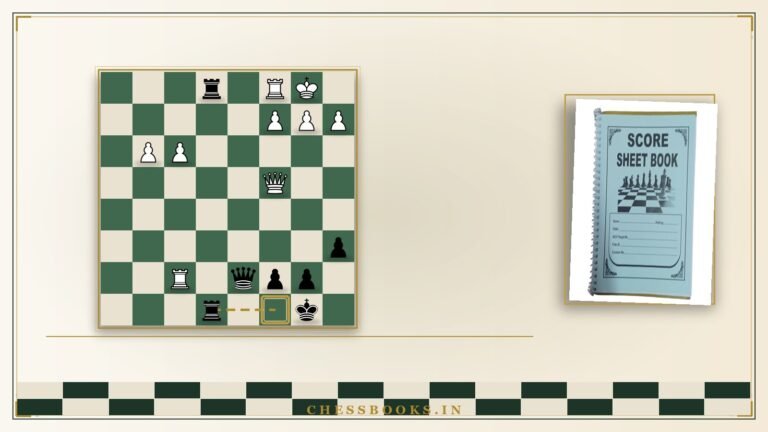
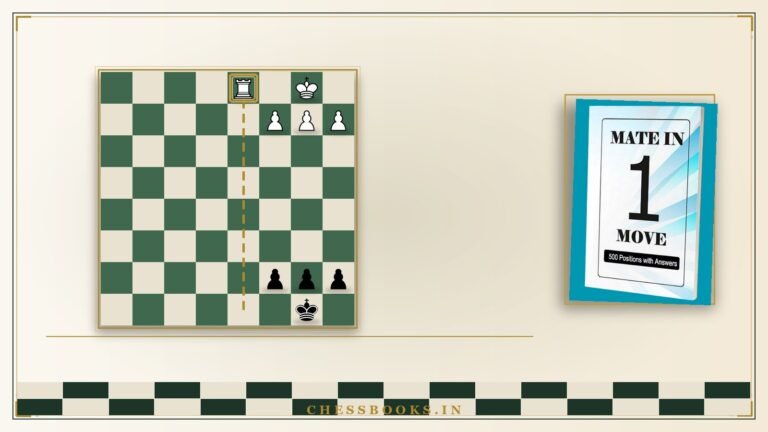
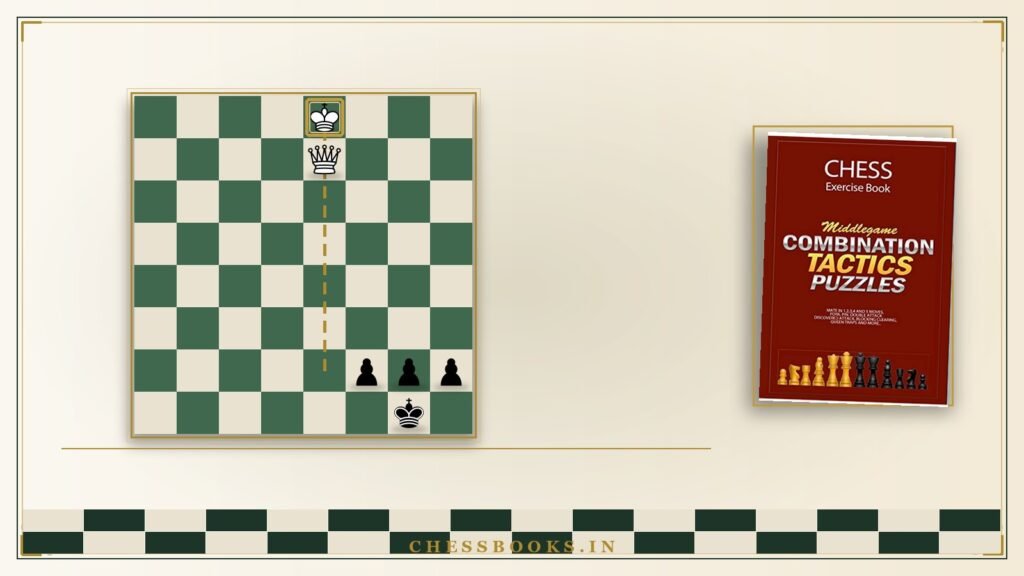
Method is built with repetition. If you want structured practice, the Chess Exercise Book — Middlegame Combinations, Tactics and Mate in 1-5 Moves works through exactly this ladder: simple mates first, then combinations and tactics as your pattern library grows. Start with 10 puzzles a day, done slowly and correctly.
Browse more chess exercise books for progression levels, and check back soon for a closer look at the patterns behind mate-in-one and how many puzzles a day you should really solve.