CHESSBOOKS.IN JOURNAL
The Square of the Pawn: An Endgame Rule Everyone Should Know
Every chess player has lost a king-and-pawn race they thought they were winning — or drawn one they should have won — because they guessed whether the king could catch the pawn. The square of the pawn replaces the guess with a visual rule you can apply in two seconds, with zero calculation.
By the end of this article you’ll be able to look at any passed pawn and instantly know whether the enemy king can catch it, when the rule lies, and how to use it in your own endings.
The rule
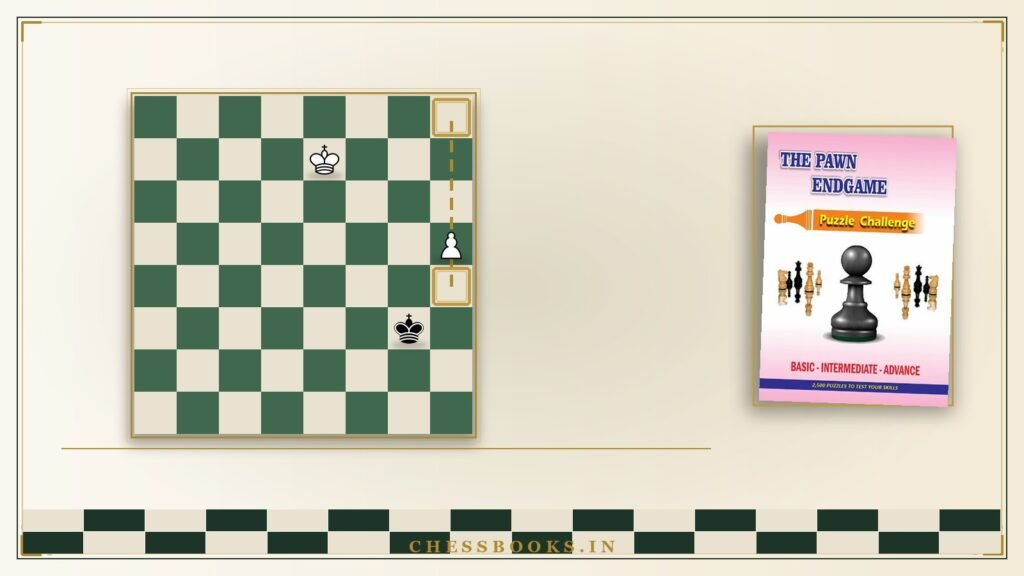
Imagine a square drawn from the pawn’s square to its promotion square, extending sideways toward the enemy king. If the king can step into that square on its move, it catches the pawn. If the king is outside the square, the pawn promotes.
In the diagram, the black king on h1 is outside the square of the d4-pawn (the square runs d4-d8 to g4-g8). The pawn runs to d8 and promotes. Notice the white king on g5 is irrelevant — the pawn races alone.
Why it works (no calculation)
In the time it takes the pawn to march from its square to promotion, the king must cover that many ranks diagonally toward it. The square draws exactly that region: one king move per rank of the pawn’s journey. If the king can’t reach the boundary on time, the pawn is home free.
Three applications
1. Catching a passed pawn
When your opponent’s pawn is running, don’t calculate — draw the square. If your king steps into it, chase and capture. If not, redirect the king or look for counterplay elsewhere.
2. Running your own pawn
When your pawn is racing, check the enemy king’s distance. If it’s outside the square, just push — every extra tempo is pure gain.
3. Choosing king routes
In endings with two pawn races, the square tells you which king route works and which wastes a tempo.
The exception beginners miss: the double step
The rule assumes the pawn moves one square at a time. But a pawn on its starting square can move two squares on its first move — which means the square shrinks by one rank before the king can act.
In practice: if the king is inside the square of a pawn still on its starting square, check whether the pawn can double-step out of the king’s reach. That one tempo is often the whole game.
Common mistakes
- Measuring from the wrong edge. The square is drawn from the pawn’s current square, not from its starting square.
- Forgetting the first-move double step. The pawn on its starting square can jump one rank before the chase begins.
- Choosing king routes that allow deflection. Walk into the square along the correct diagonal — a wrong route can let the pawn queen.
- Ignoring the rook’s pawn. The a- and h-pawns have their own corner quirks; the square still applies, but check the corner carefully.
Five king-and-pawn race puzzles
White to move in each. Decide: catch or push? Verify with the square, then play it out. Drag or click a piece.
Puzzle 1 — Enter the square
Puzzle 2 — Push the b-pawn
Puzzle 3 — The double-step exception
Puzzle 4 — Enter the square from the side
Puzzle 5 — Catch the b-pawn
Turn the rule into instinct
The square of the pawn is one rule among dozens that decide king-and-pawn endings. The Pawn Endgame Puzzle Challenge: 2,250 Puzzles drills every one of them — the square, opposition, key squares, and the races — until the visual judgement is automatic. For the fundamentals first, the Endgame Series: Pawn Endings is the gentle entry point.
Explore the full chess endings collection, and read Basic Checkmates Every Beginner Must Know for what to do once your pawn has queened.