CHESSBOOKS.IN JOURNAL
Mate in One: The Patterns Behind Every Quick Checkmate
Mate-in-one puzzles are usually the first tactical training a chess player meets — and the most underrated. They barely test calculation. What they train is pattern memory: the ability to glance at a king’s position and know instantly which mating shapes are possible. That recognition, repeated a few thousand times, is what lets stronger players finish games instead of fumbling them.
By the end of this article you will know the five families that cover almost every mate-in-one, a scan method that finds the checkmate in seconds, and eight interactive boards to practise on.
What mate-in-one training actually trains
In a mate-in-one, the first move you look at is usually right — which is exactly why coaches use them for beginners and why they still help improvers. The exercise isn’t the calculation; it’s the recognition. Your brain is building a catalogue: “king on g8, pawns on f7/g7/h7, back-rank shapes available.” Each puzzle quietly adds an entry to that catalogue.
That’s why solving them with a method matters more than the answers. A player who scans escape squares first will recognise the pattern in a real game; a player who clicks around will not.
The five mating pattern families
1. The back-rank mate
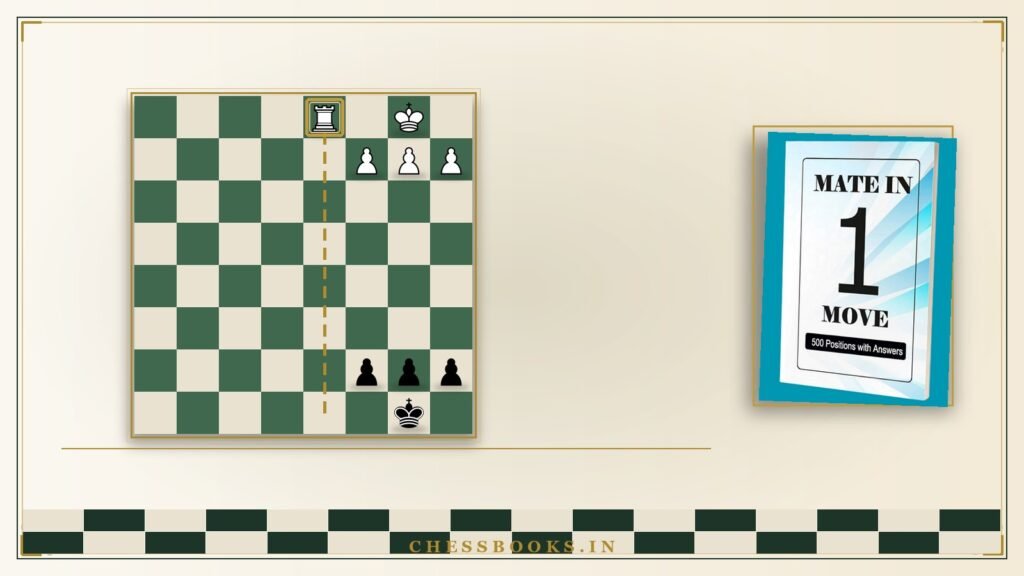
The king is trapped behind its own pawns on the first or eighth rank. A rook or queen slides onto that rank and mates. This is the most common mate in amateur chess — and the one every beginner should meet first.
2. The corridor mate
Like the back-rank mate, but the pawn wall is missing on one side, so the mating piece covers the whole rank or file by itself. Queens and rooks both deliver these.
3. The knight (smothered-style) mate
The knight is the only piece that mates a cornered king without any help, because its attack cannot be blocked. Put the king in the corner with its own pieces around it, and a knight on f7 or g6-style square does the job.
4. The queen-and-king mate
In the corner, the queen mates with the king protecting her from capture. The classic final position of the K+Q vs K endgame is this pattern.
5. The capture-the-guard mate
The mating move itself captures a defender on the mating square — a rook or queen that was covering the escape — and mates with the same move. Remove the guard and deliver mate in one tempo.
The scan method: escape squares first
Here is the method that makes mate-in-one trivial to spot:
- Count the king’s escape squares. Look at every square around the enemy king. Mark which are free.
- Find one move that covers them all. A check that simultaneously attacks every escape square (or a capture that removes a defender) is mate.
- Check the mating piece is safe. Make sure the king cannot capture it — either the piece is out of reach, or something defends it.
Worked example — back-rank mate:
Black king on g8 has escape squares f8 and h8. One rook move covers both: 1.Re8#.
Worked example — smothered knight:
King h8 has no flight squares — g8 is its own rook, g7/h7 its own pawns. 1.Nf7#. The knight attacks h8 and cannot be captured.
Worked example — queen and king corner mate:
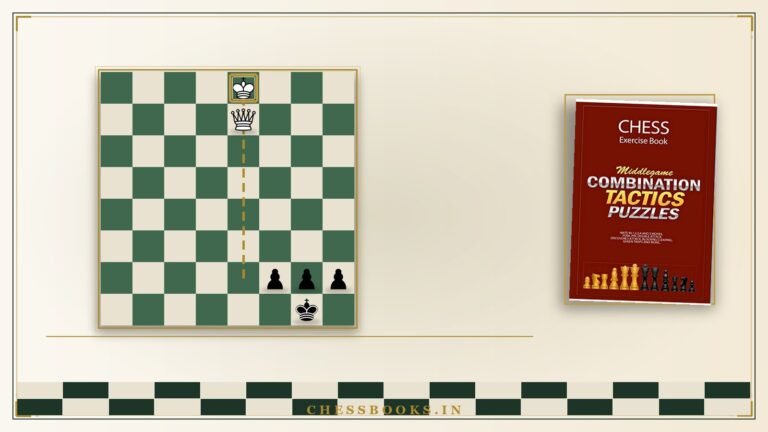
1.Qg7#. The queen mates on g7; the king on f6 stops Kxg7.
Common mistakes
- Checking with the wrong piece. A check the king can sidestep is not mate — always scan escape squares before moving.
- Forgetting the king can capture. A “mate” on a square the king can take is just a blunder of your mating piece.
- Mate moves that hang the mating piece. The mating square must be defended or unreachable.
- Ignoring stalemate. If the king has no escape squares and you have no check, you may have stalemated — a draw, not a win.
Eight mate-in-one puzzles
White to move in each. Find the escape squares, cover them all, verify the mating piece is safe. Drag or click a piece to play.
Puzzle 1 — Back-rank finish
Puzzle 2 — Smothered knight
Puzzle 3 — Corridor queen
Puzzle 4 — Capture the guard
Puzzle 5 — Two-rook ladder
Puzzle 6 — Queen and king corner
Puzzle 7 — Rook removes the guard
Puzzle 8 — Queen and pawn
Train your first 500 patterns
Recognition is built with volume. The Mate in One Move — Chess exercise book for beginners contains 500 mate-in-one puzzles arranged from simple to tricky, so the five pattern families above become automatic. Ten a day is plenty; the catalogue grows on its own.
Browse more chess exercise books, and read How to Solve Chess Puzzles the Right Way for the four-step method that makes every puzzle count — then level up with Basic Checkmates Every Beginner Must Know.