CHESSBOOKS.IN JOURNAL
Opposition: The Heart of Pawn Endings
Most king-and-pawn endings are decided before a single pawn moves. They are decided by the opposition — the rule that says which king is winning the race to the key squares. Learn this one idea and you will convert pawn endings you used to draw, and hold ones you used to lose.
By the end of this article you will understand direct and distant opposition, and you will have three interactive endings to practise on.
The rule
When two kings face each other on the same file, rank or diagonal with one square between them, the side that is not to move has the opposition. That king can advance; the other must step aside and give ground.
Why does it matter? Because in a pawn ending, the king with the opposition controls the key squares in front of the pawn. If you can walk your king into one of those squares, the pawn promotes.
Taking the opposition
The practical skill is not just recognising the rule — it is forcing your opponent to lose it. The classic method is the triangle: step aside, wait, then step back in front.
Here the white king steps sideways and forward until the black king is forced out of the d-file. Once White reaches e4 with the black king on c5, the opposition has been won and the d-pawn advances with full king support.
Distant opposition
Kings do not always stand next to each other. When there are three or five squares between them on a file, the same rule applies with the squares in between — that is distant opposition. Counting the squares between the kings tells you who is winning the long race.
Counting is simple: if the number of squares between the kings is odd (1, 3, 5), the side not to move holds the opposition. If even (2, 4), the side to move holds it. In pawn races this decides which king reaches the key square first.
The pawn on the 5th
The most famous application: a passed pawn on the fifth rank with the king in support is nearly always a win — if you use the opposition correctly.
The key move is 1.Kc5!, stepping around the pawn to reach the key squares c6/d6/e6. From there the pawn walks to the 6th and promotes. The opposition is what forces the black king to give way at every step.
Common mistakes
- Pushing the pawn too early. The pawn is a tool of the king, not the other way around. Walk the king first.
- Moving straight into the opposition. If your king advances into a face-off, you just handed the opposition away. Step aside first.
- Forgetting stalemate. Pushing a pawn to the 7th with the defending king in front can produce stalemate. Check for it before every push.
- Ignoring distant opposition. Races are won by counting, not by intuition.
Practise it
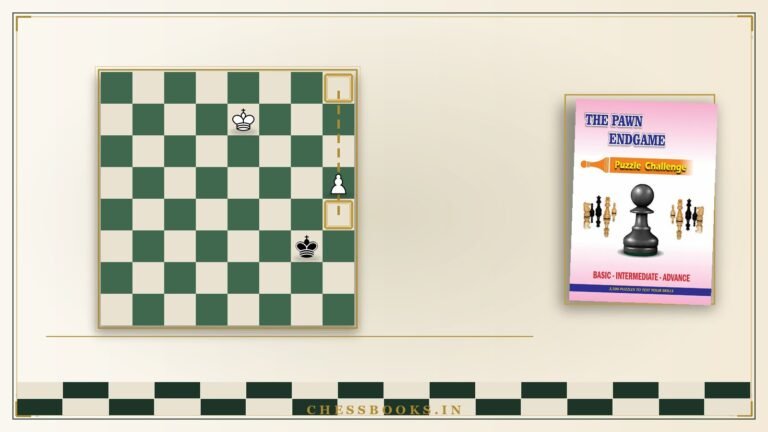
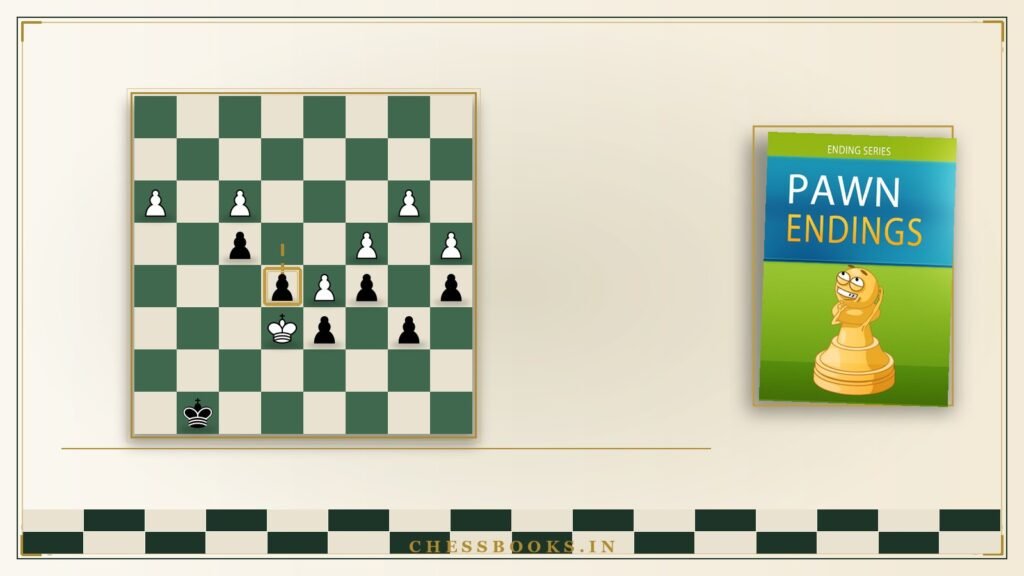
The Endgame Series: Pawn Endings is a 269-puzzle course on exactly these ideas — opposition, key squares and the square of the pawn — in increasing difficulty. For deeper volume, the Pawn Endgame Puzzle Challenge (2,250 puzzles) turns the rule into instinct.
Browse the full chess endings collection, and continue with The Square of the Pawn — the other rule that decides pawn endings.