

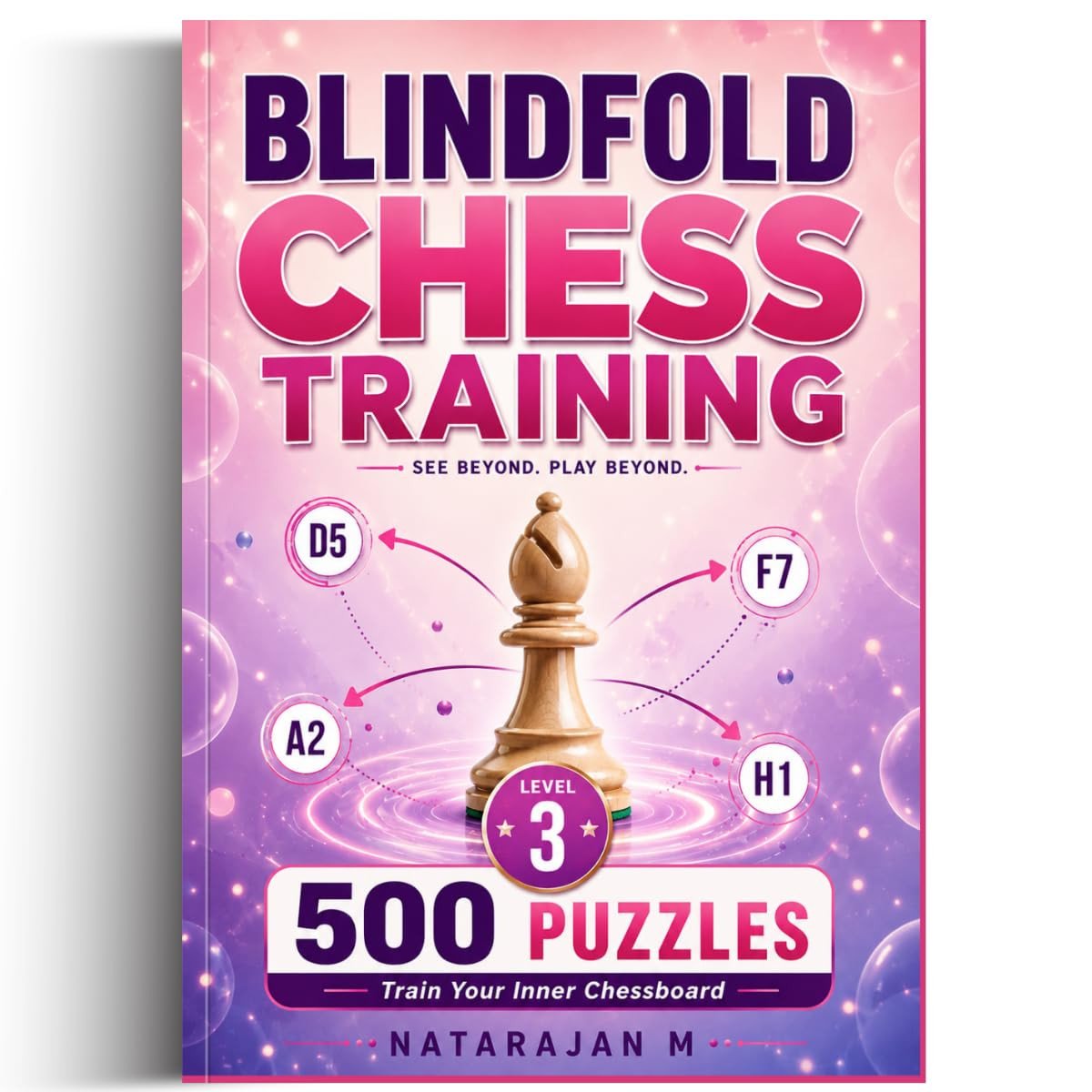
Blindfold Chess Training - Level 3: Advanced | Calculate sacrifices and deflections with 5-10 pieces, 4 moves deep.
MRP inclusive of all taxes
In stock — ready to ship
Blindfold Chess Training — Level 3: Advanced features 500 advanced tactical puzzles drawn from real competitive chess games. Each position contains 5 to 10 pieces — the dense, complex type of position you encounter in the transition from endgame to early middlegame. You must reconstruct the entire position from coordinates alone, then find the winning continuation, which may involve sacrifices, deflections, clearance moves, or multi-move forced sequences up to 4 moves deep.
1000 in stock
Description
Tournament chess is decided in the mind, not on the board. At this level, the player who can hold 10 interacting pieces in their head and calculate a sacrifice four moves deep is the player who walks home with the trophy.
You have moved beyond beginner blunders. You understand pins, forks, and basic endgame technique. But in competitive rated games, something still goes wrong: you calculate a promising sacrifice, your mind tracks the first three moves perfectly, and then on the critical fourth move — the position falls apart in your head. A pawn you forgot about blocks the diagonal. A rook you lost track of defends the key square. The combination that looked crushing turns out to lose material. This is not a tactical knowledge problem. This is a visualization capacity problem — and Level 3 is built specifically to solve it.
Blindfold Chess Training — Level 3: Advanced features 500 advanced tactical puzzles drawn from real competitive chess games. Each position contains 5 to 10 pieces — the dense, complex type of position you encounter in the transition from endgame to early middlegame. You must reconstruct the entire position from coordinates alone, then find the winning continuation, which may involve sacrifices, deflections, clearance moves, or multi-move forced sequences up to 4 moves deep.
How Does the Training Work?
- Read the Piece Coordinates: Each puzzle describes a tactical position with 5 to 10 pieces using text coordinates only. For example: “White: King on g1, Queen on d1, Rook on e1, Bishop on b5, Pawn on d4, Pawn on f2. Black: King on e8, Rook on a8, Knight on c6, Pawn on d6, Pawn on e5. White to move.”
- Reconstruct the Full Position Mentally: Build the complete board state in your head. Map out every open file, every diagonal, every pawn chain. Identify the tactical features: pinned pieces, overloaded defenders, weak back ranks, and vulnerable king positions.
- Calculate the Winning Combination: Find the 1 to 4 move forced solution entirely in your mind. The answer may require a sacrifice to deflect a defender, a clearance move to open a line, a discovered attack, or a deep forcing sequence. Write your answer down.
- Verify with the Full Board Diagram: Check the solutions section where every puzzle features a complete board diagram with the correct answer displayed, so you can compare your mental reconstruction against the actual position.
What You Will Find Inside Level 3:
- 500 Advanced Tournament-Grade Puzzles: Positions sourced from competitive chess games featuring realistic tactical complexity — not artificial constructions, but positions that could appear in your next rated tournament game.
- 5 to 10 Pieces Per Position: This is the sweet spot of tactical chess — enough pieces to create complex interactions between major and minor pieces, pawn structures, and king safety considerations, but not so many that the position becomes an exercise in memorisation rather than calculation.
- Deep Calculation Requirements (1–4 Moves): Solutions in Level 3 regularly demand that you calculate three or four moves deep, holding the changing board state through multiple piece exchanges, captures, and positional changes.
- Real Tactical Themes You Will Master: Exchange sacrifices (giving up a rook for a minor piece to expose a king), deflection sacrifices (forcing a defender away from a critical square), clearance moves (moving your own piece off a line to unleash an attack), intermediate moves (zwischenzug), discovered attacks and discovered checks, and multi-step mating patterns.
- No Board Diagrams on Puzzle Pages: Coordinate-only format forces deep mental reconstruction of complex positions.
- Full High-Contrast Diagram Solutions: Every answer includes a professionally designed board diagram for instant verification.
- Write-In Answer Spaces: Dedicated notation areas for recording your solutions during self-study.
- Professional Print Layout: Clean, tournament-grade formatting designed for extended training sessions.
Skills You Will Build:
- Complex Position Reconstruction: Hold up to 10 pieces in your working memory simultaneously — including tracking which squares they attack, defend, and control. This is the level of visualization required for competitive rated play.
- Sacrifice Calculation: Develop the confidence to visualize a position after giving up material and verify that the resulting position is winning — a critical skill that separates tournament players from casual players.
- Multi-Move Forced Sequence Tracking: Train your mind to hold a three or four-move variation in memory, updating the board state after each move without losing track of any piece.
- Defensive Awareness: Learn to spot your opponent’s defensive resources (blocks, interposes, counter-attacks) during your calculation, preventing you from playing unsound sacrifices.
- Board Geometry Mastery: Develop an intuitive understanding of which squares connect via diagonals, knight jumps, and open files — the geometric knowledge that powers expert-level calculation.
Who Is This Book For?
- Tournament Players: You are a serious competitive player preparing for rated tournaments, league matches, or FIDE-rated events. This book builds the calculation precision required to compete at this level.
- Players Who Completed Levels 1 and 2: If you have worked through the beginner and intermediate blindfold puzzles and want a genuine step up in difficulty, Level 3 delivers.
- Online Rapid and Classical Players: If you perform well in puzzles but consistently underperform in actual games, this book bridges the gap by training the exact mental process you use during live play.
- Chess Coaches and Academy Trainers: Ideal homework material for advanced students. Use as weekly assignments, timed assessment tests, or classroom group-solving exercises.
- Self-Improvers Targeting the 2000 Rating Barrier: Breaking through the barrier requires reliable tactical vision. This book systematically builds that reliability.
What Makes Level 3 Different from Level 2?
Level 2 introduced multi-piece tracking with up to 7 pieces and 1–3 move solutions. Level 3 makes a significant jump: with 5 to 10 pieces on the board, the positions now include pawn structures, piece coordination, and genuine middlegame complexity. The solutions are deeper (up to 4 moves) and more demanding — you will encounter sacrifices, deflections, and intermediate moves that require you to hold multiple branching lines in your head simultaneously. This is where your blindfold training transforms from a cognitive exercise into a genuine competitive weapon.
This is Book 3 of the progressive 5-book Blindfold Chess Training series. Push further with Level 4 (10–16 pieces for Master-level training) and Level 5 (12–24 pieces for Grandmaster-level challenges).
The tournament hall does not forgive visualization errors. Train now, calculate precisely, and win the games that matter. Scroll up, click “Buy Now,” and conquer 500 advanced blindfold puzzles today!
Product details
| Type | Paper Back |
|---|---|
| Publisher | Prakash Enterprises |
| Size | A4 - (205 x 292 MM) |
| Pages | 140 |
1 review for Blindfold Chess Training – Level 3: Advanced | Calculate sacrifices and deflections with 5-10 pieces, 4 moves deep.
There are no reviews yet.