

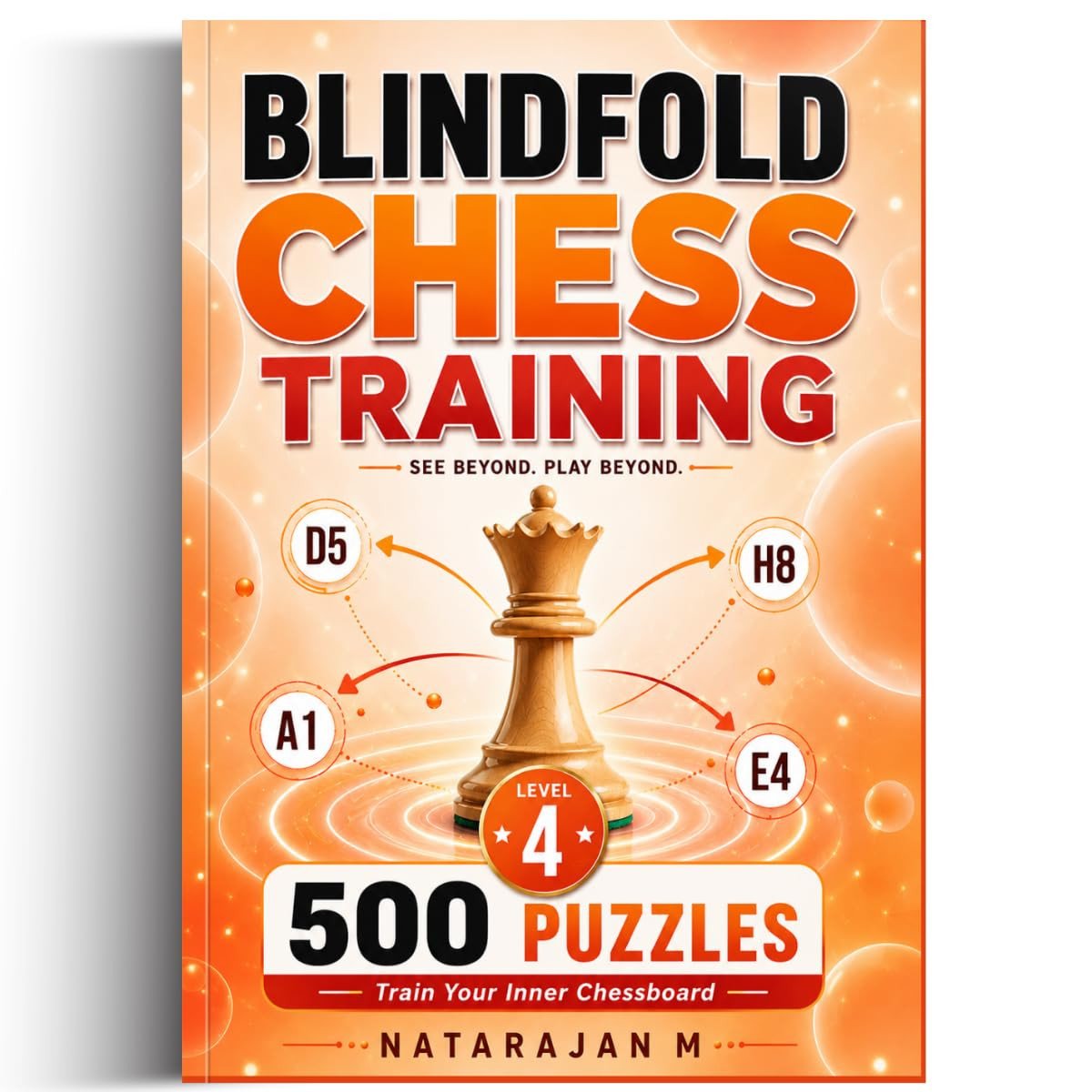
Blindfold Chess Training - Level 4: Master - 500 Puzzles for Elite Board Vision | Solve 500 complex middlegames
MRP inclusive of all taxes
In stock — ready to ship
Blindfold Chess Training — Level 4: Master features 500 expert-level puzzles drawn from competitive master and international master games. Each position contains 10 to 16 pieces — dense, complex middlegame configurations where multiple tactical motifs interact simultaneously. You must reconstruct these rich positions entirely from text coordinates, then calculate the winning combination, which may span up to 5 moves and involve intermezzos, x-ray attacks, piece overloading, defensive resources, and multi-branch decision trees.
999 in stock
Description
At the master level, a single miscalculated intermezzo can turn a won position into a loss. You need absolute certainty in your mental board — and the ability to reconstruct 16 interacting pieces from coordinates alone. Level 4 builds that certainty.
The journey from Expert to Candidate Master and beyond is one of the hardest climbs in chess. You have spent years building your opening repertoire, studying endgame theory, and sharpening your tactical eye. Yet at this level, the games are no longer decided by simple tactical tricks — they are decided by the depth, accuracy, and reliability of your calculation. One miscounted square. One forgotten pawn. One intermezzo you did not anticipate. At the master level, these microscopic errors cost you the full point. The solution is not more tactical patterns — it is stronger, more reliable visualization.
Blindfold Chess Training — Level 4: Master features 500 expert-level puzzles drawn from competitive master and international master games. Each position contains 10 to 16 pieces — dense, complex middlegame configurations where multiple tactical motifs interact simultaneously. You must reconstruct these rich positions entirely from text coordinates, then calculate the winning combination, which may span up to 5 moves and involve intermezzos, x-ray attacks, piece overloading, defensive resources, and multi-branch decision trees.
How Does the Training Work?
- Read the Piece Coordinates: Each puzzle presents a complex middlegame position with 10 to 16 pieces, described entirely in text. You will encounter multiple pieces per side, intricate pawn structures, and realistic board configurations from master-level games.
- Reconstruct the Dense Position Mentally: Build the entire middlegame position in your head. Map out the pawn skeleton first, then place the major pieces (queens, rooks) and minor pieces (bishops, knights). Identify the critical tactical features: overloaded defenders, weak squares, open files pointing at the enemy king, and potential x-ray geometries.
- Calculate the Deep Combination: Find the 1 to 5 move winning combination entirely in your mind. At this level, solutions frequently involve intermediate moves (zwischenzug) — unexpected checks or threats inserted between expected moves that disrupt your opponent’s defensive plan. Write your complete variation down.
- Verify with the Full Board Diagram: The solutions section features detailed board diagrams for every puzzle, allowing you to check both your mental reconstruction and your calculated variation against the correct answer.
What You Will Find Inside Level 4:
- 500 Master-Level Tactical Puzzles: Complex middlegame positions from real master and international master games — not simplified endgames, but the dense, multi-threat positions you face across the board in serious competitive play.
- 10 to 16 Pieces Per Position: This is the genuine middlegame piece density. You must hold the positions of up to 16 pieces — including complete pawn structures, both bishops, knights, rooks, queens, and kings — entirely in your working memory.
- Solutions Up to 5 Moves Deep: The calculation depth at this level is demanding. Solutions may involve quiet moves, defensive resources, and multi-branch decision points that require you to evaluate several candidate moves before identifying the correct one.
- Advanced Tactical Themes: Intermezzos (zwischenzug) that insert unexpected moves into forced sequences, x-ray attacks through occupied squares, overloaded defenders that cannot protect two threats simultaneously, piece sacrifices to destroy pawn cover, queen sacrifices with forced mating nets, and defensive resource identification to avoid unsound attacks.
- Realistic Pawn Structures: Unlike simpler levels, Level 4 positions feature full pawn chains, isolated pawns, backward pawns, and passed pawns — all of which must be tracked in your mental image alongside the pieces.
- Full Diagram Solutions: High-quality board diagrams for every answer in the solutions section.
- Write-In Answer Spaces: Record your complete calculated variations during self-study.
- Premium Print Layout: Professional formatting optimised for extended deep-study sessions.
Skills You Will Build:
- High-Density Mental Reconstruction: Holding 10 to 16 pieces in your working memory simultaneously represents a near-complete board state. Mastering this level means your mental board is sharp enough for virtually any position you will encounter in competition.
- Intermezzo Detection: Learn to anticipate intermediate moves — both your own and your opponent’s — during long forced sequences. This is the tactical skill that defines master-level play.
- Multi-Branch Calculation: Train your mind to hold multiple candidate move lines simultaneously and compare their outcomes — the mental process required for evaluating critical positions.
- Pawn Structure Awareness: Develop the ability to track pawn structures in your head alongside pieces, which is essential for accurate middlegame calculation.
- Defensive Resource Spotting: Learn to check your opponent’s best defensive replies before committing to an attack, preventing you from playing unsound combinations in tournament games.
Who Is This Book For?
- Expert and Candidate Master Players: You are competing at a high level and need iron-clad calculation to make the final push toward the master title.
- FIDE-Rated Tournament Competitors: If you play in FIDE-rated events, national championships, or international opens, this workbook builds the calculation reliability demanded at those levels.
- Players Who Completed Levels 1–3: This is the natural next step in the progressive series, and represents a substantial difficulty jump from Level 3.
- Serious Online Players: If your online rating is strong but your OTB results are disappointing, this book builds the deep calculation skill that online play does not develop.
- Chess Coaches Working with Advanced Students: Use these 500 puzzles as master-class training material, timed challenge sets, or diagnostic assessments for your top students.
What Makes Level 4 Different from Level 3?
Level 3 introduced 5–10 piece positions with sacrifices and deflections. Level 4 makes a critical jump into full middlegame density. With 10 to 16 pieces, you must now track complete pawn structures alongside major and minor pieces. The solutions are deeper (up to 5 moves), and the tactical themes are more sophisticated — intermezzos, x-ray attacks, and overloaded defenders replace the simpler forks and pins of earlier levels. This is the level where your blindfold training reaches professional standards and directly impacts your competitive results.
This is Book 4 of the progressive 5-book Blindfold Chess Training series. Complete the journey with Level 5 (12–24 pieces for the ultimate Grandmaster-level challenge).
At the master level, there are no easy points — only precise calculation and flawless board vision. Scroll up, click “Buy Now,” and train with 500 of the most demanding blindfold puzzles ever assembled!
Product details
| Type | Paper Back |
|---|---|
| Publisher | Prakash Enterprises |
| Size | A4 - (205 x 292 MM) |
| Pages | 140 |

1 review for Blindfold Chess Training – Level 4: Master – 500 Puzzles for Elite Board Vision | Solve 500 complex middlegames
There are no reviews yet.