

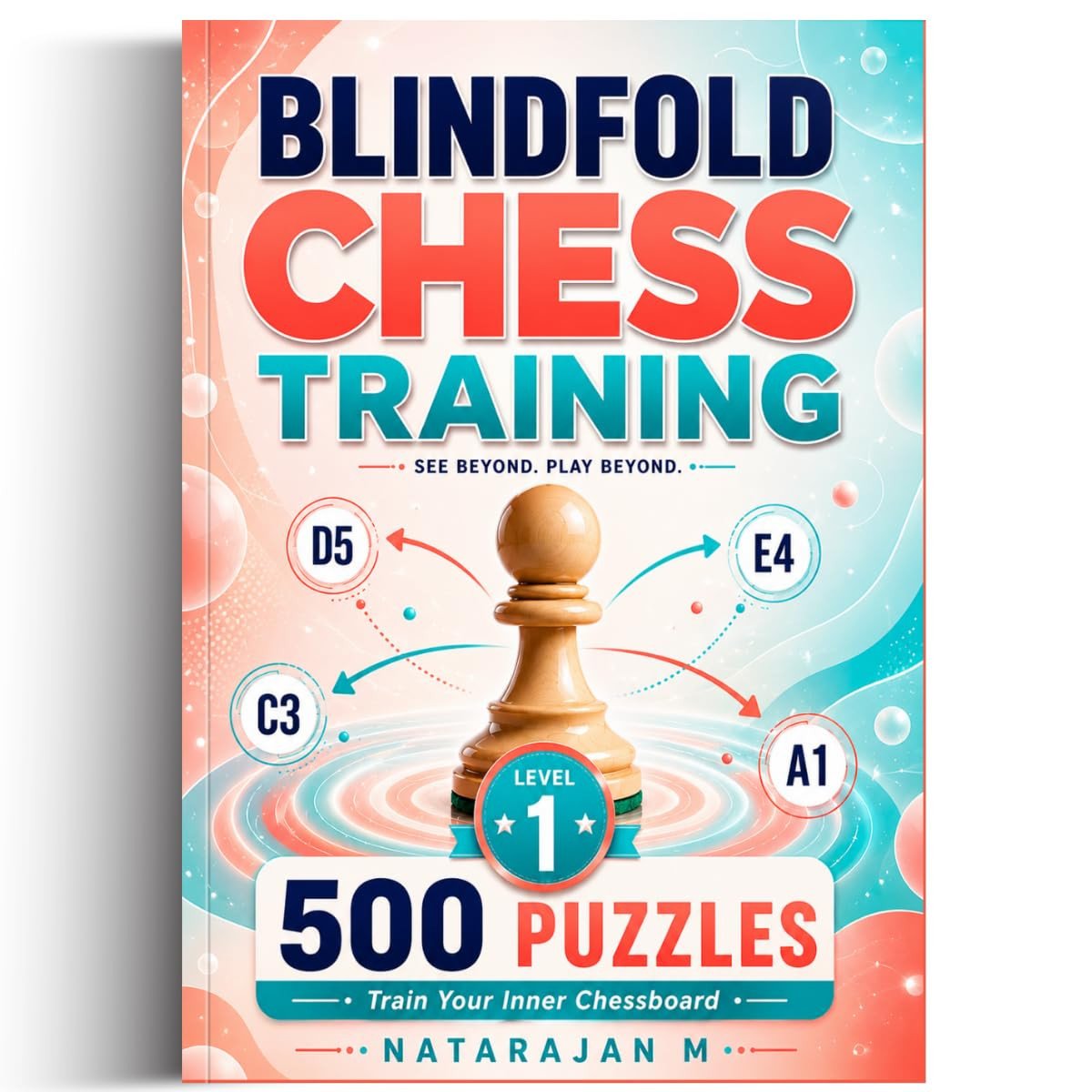
Blindfold Chess Training - Level 1: Beginner
MRP inclusive of all taxes
In stock — ready to ship
Blindfold Chess Training — Level 1: Beginner is the first book in a progressive 5-book series designed to build your mental chessboard from the ground up. Unlike any other chess puzzle book on the market, this workbook removes the board diagram entirely from the puzzle page. Instead, you are given only the text coordinates of 2 to 5 chess pieces. Your job is to reconstruct the position in your mind, locate every threat and defended square, and find the winning move — all without looking at any diagram.
998 in stock
Description
What if you could close your eyes and see all 64 squares of the chessboard perfectly — every rank, every file, every diagonal? That is not a gift reserved for grandmasters. It is a learnable skill, and this book is where you start.
Most chess players hit a wall early in their journey. You study openings, memorise tactical patterns, and watch hours of instructional videos — yet you still drop pieces to simple one-move threats. Why? Because your mental chessboard is incomplete. When you try to calculate even two moves ahead, the board becomes blurry, pieces seem to teleport, and open lines vanish from your memory. The root cause is not a lack of talent — it is a lack of structured visualization training.
Blindfold Chess Training — Level 1: Beginner is the first book in a progressive 5-book series designed to build your mental chessboard from the ground up. Unlike any other chess puzzle book on the market, this workbook removes the board diagram entirely from the puzzle page. Instead, you are given only the text coordinates of 2 to 5 chess pieces. Your job is to reconstruct the position in your mind, locate every threat and defended square, and find the winning move — all without looking at any diagram.
How Does Blindfold Training Work?
- Read the Piece Coordinates: Each puzzle gives you a plain-text description of where every piece stands. For example: “White: King on e1, Queen on d5. Black: King on h8, Pawn on g7. White to move.” There is no board diagram on the puzzle page — just text.
- Build the Board in Your Mind: Close your eyes or look away from the page. Place each piece on its square inside your head. Notice which squares are attacked, which diagonals are open, and where the kings can escape.
- Find the Winning Move: Calculate the solution — typically a 1-move checkmate, a fork, or a simple material-winning tactic — entirely in your mind. Write your answer down in the space provided.
- Verify with the Diagram Solution: Flip to the solutions section at the back of the book. Every single puzzle includes a full, high-contrast chess board diagram showing the correct answer, so you can instantly see whether your mental image was accurate.
What You Will Find Inside Level 1:
- 500 Carefully Curated Beginner Puzzles: Every position is handpicked to teach a specific visualization skill — from locating a king on the back rank to spotting a simple queen fork across the board.
- Only 2 to 5 Pieces Per Puzzle: The low piece count is intentional. With fewer pieces, your brain can focus on building an accurate mental image without being overwhelmed. This is the critical first step that most chess books skip.
- Pure Endgame Positions: King vs. King and Pawn, King and Rook vs. King, King and Queen vs. King — these fundamental endgame patterns form the backbone of your new mental board map.
- No Board Diagram on Puzzle Pages: This is the core mechanic. By removing the crutch of a visual diagram, your brain is forced to build and hold the position internally. This is the exact same process your mind uses when calculating variations during a live game.
- Full Diagram Solutions for Every Puzzle: The solutions section features large, clear, high-contrast board diagrams so you can instantly verify your mental image and identify where your visualization broke down.
- Write-In Answer Spaces: Each puzzle includes a dedicated space to write your answer in standard algebraic notation — reinforcing the connection between coordinates and the physical board.
- Clean, Professional Print Layout: No cluttered margins, no decorative filler, no wasted pages. Just clean typography, generous spacing, and a design optimized for focused self-study sessions.
Skills You Will Build:
- Coordinate Fluency: You will learn to instantly associate algebraic notation (a1, b2, e4, h8) with their physical positions on the board — the foundational skill of all chess calculation.
- Square Colour Awareness: You will begin to naturally “see” whether a square is light or dark without looking, which is critical for bishop and diagonal calculation.
- Basic Threat Detection: You will learn to identify checks, captures, and one-move threats purely from coordinate information.
- Working Memory Expansion: By holding 2 to 5 piece positions in your head, you begin training the exact cognitive muscle that powers all deep chess calculation.
Who Is This Book For?
- Absolute Beginners (Unrated to 1200 ELO): If you are new to chess or still learning the rules, this book will build your internal board map from Day 1.
- Kids and Junior Players (Ages 8+): The simple piece counts and short solutions make this an ideal workbook for young chess students working with a coach or parent.
- Adult Learners Returning to Chess: If you played chess casually years ago and want to rebuild your skills with a structured programme, start here.
- Chess Coaches and Trainers: Use these 500 puzzles as homework assignments, classroom exercises, or assessment materials for beginner students.
- Casual Players Who Want to Stop Dropping Pieces: If you keep losing material to simple one-move blunders, your visualization is the bottleneck — and this book fixes it.
What Makes This Book Different from Other Chess Puzzle Books?
Standard chess puzzle books show you a diagram and ask you to find the best move. That trains pattern recognition, not visualization. In a real game, you cannot physically move pieces to check your calculation — you must hold the future position in your head. This book trains that exact skill by removing the diagram and forcing you to build the board from coordinates. It is the chess equivalent of an athlete training with a blindfold to sharpen their spatial awareness.
This is Book 1 of a 5-book progressive series. After completing Level 1, you can advance to Level 2 (3–7 pieces), Level 3 (5–10 pieces), Level 4 (10–16 pieces), and Level 5 (12–24 pieces) to systematically expand your mental chessboard to grandmaster levels.
Your mental chessboard is waiting to be built. Scroll up, click “Buy Now,” and start solving your first 500 blindfold puzzles today. You will be amazed at how quickly your board vision sharpens!
Product details
| Type | Paper Back |
|---|---|
| Publisher | Prakash Enterprises |
| Size | A4 - (205 x 292 MM) |
| Pages | 140 |
2 reviews for Blindfold Chess Training – Level 1: Beginner
There are no reviews yet.