

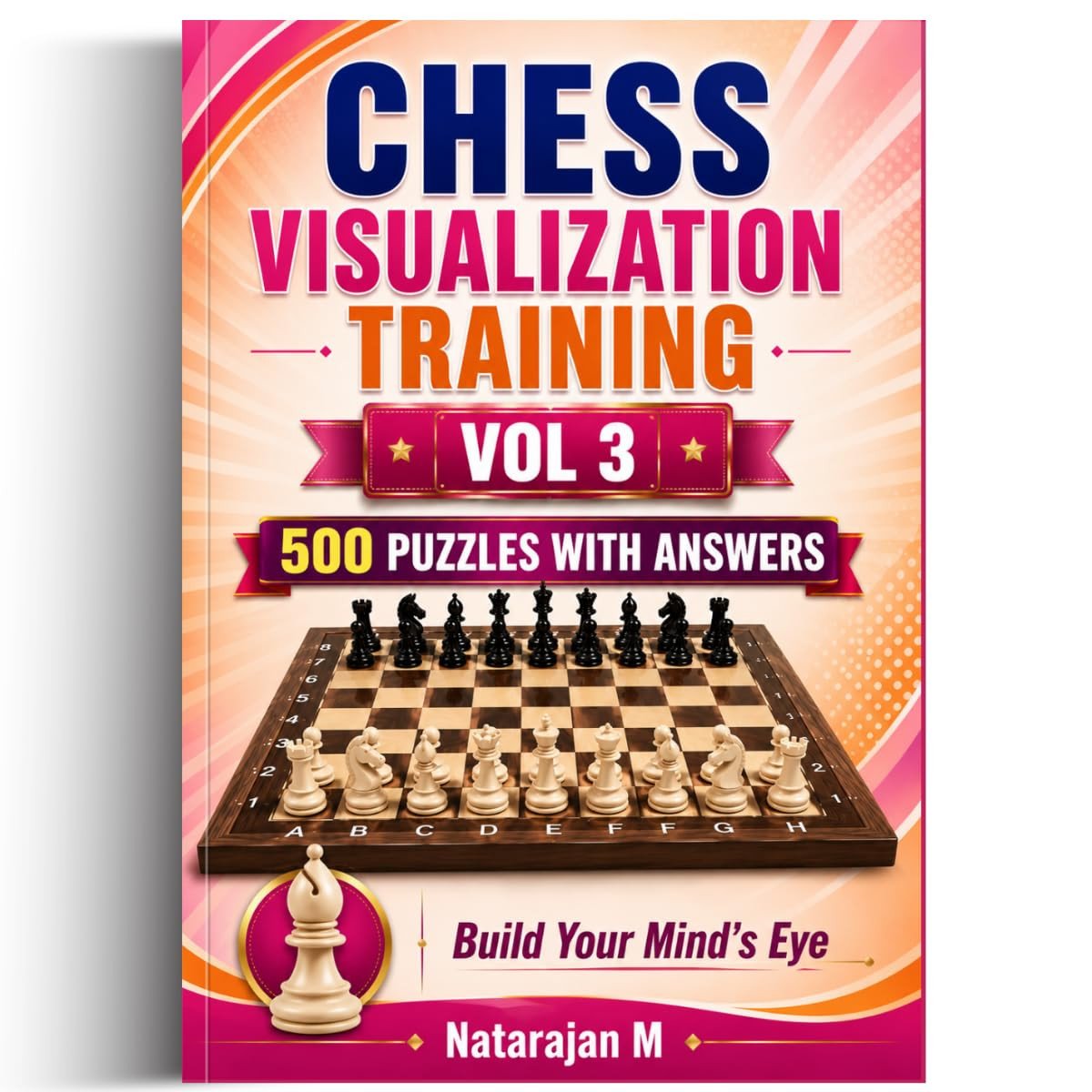
Chess Visualization Training - Volume 3: 500 Chess Puzzles | Reconstruct advanced middlegames mentally
MRP inclusive of all taxes
In stock — ready to ship
Chess Visualization Training — Volume 3: Four-Move Sequences pushes your visualization depth into genuinely challenging territory. Starting from a printed diagram, you must play 6 to 7 half-moves (plies) in your head, then find a tactical solution spanning 3 to 4 moves. Your total mental calculation from the printed diagram to the final solution covers approximately 10 half-moves — a depth that separates tournament winners from tournament participants.
999 in stock
Description
At the advanced level, winning combinations are not sitting on the surface — they are buried four moves deep behind sacrifices, deflections, and intermediate moves. Volume 3 trains your mind’s eye to dig deep enough to find them.
You have played enough chess to know this truth: the most beautiful combinations in chess are almost never obvious from the starting position. The brilliant sacrifice that wins the game only works because of what happens four moves later — a deflection that forces a defender away, an intermediate move that gains a critical tempo, or a quiet move that creates an inescapable threat. To play these combinations in a real game, you must see the position four full moves into the future with total clarity. If your mental image is even slightly wrong at any step — if you misremember one pawn, miscalculate one capture — the entire combination collapses.
Chess Visualization Training — Volume 3: Four-Move Sequences pushes your visualization depth into genuinely challenging territory. Starting from a printed diagram, you must play 6 to 7 half-moves (plies) in your head, then find a tactical solution spanning 3 to 4 moves. Your total mental calculation from the printed diagram to the final solution covers approximately 10 half-moves — a depth that separates tournament winners from tournament participants.
How Does the Training Work?
- Study the Printed Diagram: Examine the starting position carefully. At this level, positions are complex middlegame configurations with multiple tactical tensions and strategic features.
- Read the 4-Move Transition Sequence: Below the diagram, read the four-move sequence. These transitions feature piece exchanges, sacrifices, pawn breaks, and positional manoeuvres that dramatically alter the board landscape.
- Visualize the Board After All 4 Moves: Play the entire 6–7 ply sequence in your head. This is the critical step — you must track every piece movement, every capture, every pawn change, and every line that opens or closes. The position you build in your mind must be perfect, because the tactical solution depends on it.
- Find the Deep Combination: From your visualized position, calculate the 3 to 4 move winning continuation. Solutions at this level frequently involve sacrifices that create mating nets, deflections that expose overloaded defenders, and intermediate checks that win decisive tempos. Write your complete variation.
- Verify with the Solutions Page: Confirm your mental reconstruction and tactical answer against the step-by-step solution at the back of the book.
What You Will Find Inside Volume 3:
- 500 Advanced Tactical Puzzles: Complex tournament-grade positions where the winning combination is hidden behind multiple layers of forced play. These are the positions where calculation ability — not pattern recognition — decides the outcome.
- Deep Visualization Transitions (6–7 Plies): The four-move transition sequences are significantly more complex than Volumes 1 and 2. You must process captures, recaptures, piece exchanges, and positional changes across nearly a full page of notation — all in your head.
- Multi-Move Solutions (3–4 Moves): The tactical answers are no longer simple one-move checkmates. You will need to calculate complete forcing sequences — sacrifice, response, follow-up, and conclusion — holding each intermediate position in your working memory.
- Advanced Tactical Themes: Exchange sacrifices to expose the enemy king, deflection sacrifices to remove key defenders, intermediate moves (zwischenzug) inserted between forced sequences to gain decisive material or tempo, clearance sacrifices to open lines for a decisive attack, piece overloading (one defender forced to guard two threats), and complex mating patterns requiring precise piece coordination.
- “Turn to Move” Badge: Clear visual indicator of which side plays the solution move.
- Complete Solution Notation: Full algebraic notation matching the visualized coordinates for easy verification.
- Professional Grayscale Print Layout: Optimised for extended, focused study sessions.
Skills You Will Build:
- Deep-Sequence Visualization: Holding a board state through 6 to 7 plies of changes is a serious cognitive achievement. This is the visualization depth required for competitive tournament chess at this level.
- Sacrifice Evaluation Under Visualization: One of the hardest skills in chess is evaluating a sacrifice when you cannot see the resulting position physically. This book forces you to visualize the post-sacrifice position and verify it is winning — building confidence in your sacrificial calculations.
- Intermediate Move Detection: Zwischenzug (intermediate moves) are the tactical weapon of choice at the advanced level. By repeatedly encountering them in visualization exercises, you develop the instinct to check for them in your own calculations.
- Multi-Branch Calculation Stamina: At this depth, positions often have multiple candidate continuation lines. You will build the mental stamina to evaluate several lines and select the best one without losing focus.
- Pressure-Proof Calculation: The ability to calculate accurately through complex sequences — even under the mental pressure of a long transition — builds the resilience you need during critical tournament moments.
Who Is This Book For?
- Advanced Club and Tournament Players: You compete regularly and need to sharpen your calculation for critical game moments where deep combinations decide the outcome.
- Players Who Completed Volumes 1 and 2: You have built solid visualization fundamentals and are ready for a genuine challenge. Volume 3 marks the transition from intermediate to advanced training.
- Players Struggling to Find Deep Combinations in Games: If you often see the correct combination in post-game analysis (“I could have played Bxh7+!”) but missed it during the game because you could not visualize deep enough, this book directly trains the skill you are missing.
- Aspiring Tournament Winners: Club championship titles are won by players who can calculate one move deeper than their opponents. This book builds that edge.
- Chess Coaches Working with Advanced Students: Ideal training material for students pushing toward advanced levels.
What Makes Volume 3 Different from Volume 2?
Volume 2 used 4–5 ply transitions with 2–3 move solutions — a solid intermediate challenge. Volume 3 makes a substantial leap: 6–7 ply transitions force you to hold nearly twice as much changing information, and 3–4 move solutions require you to calculate genuine multi-move forced sequences. The tactical themes also evolve — you will encounter sacrifice-based combinations, deflections, and intermediate moves that rarely appear in simpler puzzle books. This is the volume where your visualization training crosses into advanced territory and begins producing visible results in your competitive games.
This is Volume 3 of the progressive 5-volume Chess Visualization Training series. Continue with Volume 4 (5-move sequences) and Volume 5 (advanced deep visualization) for master and grandmaster-level calculation training.
The deepest combinations are invisible to most players — but not to you. Train your mind’s eye to see them. Scroll up, click “Buy Now,” and solve 500 advanced visualization puzzles today!
Product details
| Type | Paper Back |
|---|---|
| Publisher | Prakash Enterprises |
| Size | A4 - (205 x 292 MM) |
| Pages | 140 |
2 reviews for Chess Visualization Training – Volume 3: 500 Chess Puzzles | Reconstruct advanced middlegames mentally
There are no reviews yet.