

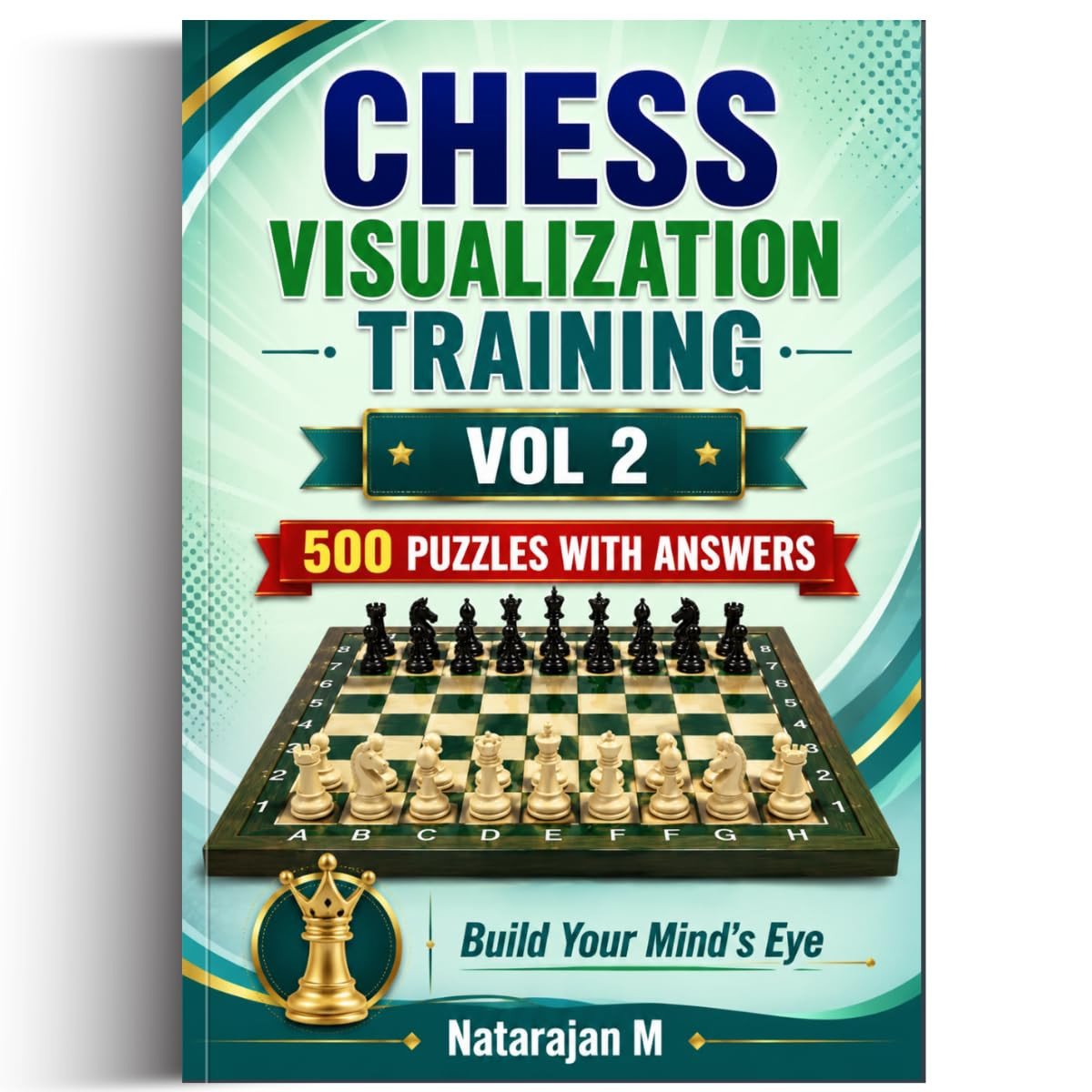
Chess Visualization Training - Volume 2: 500 Chess Puzzles | Play 3 transition moves in your head
MRP inclusive of all taxes
In stock — ready to ship
Chess Visualization Training — Volume 2: Three-Move Sequences extends your visualization depth to 4 to 5 half-moves (plies). Starting from a printed diagram, you will play 3 full transition moves in your head, then find the winning tactical continuation — which itself may be 2 to 3 moves deep. This means your total mental calculation spans 6 to 8 half-moves from the printed position, building the kind of deep, reliable vision that wins club championships.
1000 in stock
Description
Two moves ahead is not enough. At the club level, the player who can see three moves ahead — tracking every capture, every exchange, and every open line — is the player who wins the critical games. Volume 2 doubles your visualization depth.
You have learned to visualize short sequences. But in competitive games, two moves ahead barely scratches the surface. Your opponent sacrifices a piece on move one, you recapture on move two, and then on move three — what does the board look like? Where did the pawn land after the exchange? Is the diagonal now open or blocked? Is your king exposed or safe? If you cannot answer these questions from memory — without moving any physical pieces — you are calculating blind. And calculating blind at the club level means losing games you should be winning.
Chess Visualization Training — Volume 2: Three-Move Sequences extends your visualization depth to 4 to 5 half-moves (plies). Starting from a printed diagram, you will play 3 full transition moves in your head, then find the winning tactical continuation — which itself may be 2 to 3 moves deep. This means your total mental calculation spans 6 to 8 half-moves from the printed position, building the kind of deep, reliable vision that wins club championships.
How Does the Training Work?
- Study the Printed Diagram: Examine the high-quality grayscale board diagram on the puzzle page. Identify all pieces, the pawn structure, king safety, and key tactical features.
- Read the 3-Move Transition Sequence: Below the diagram, read the three-move sequence in algebraic notation. These moves typically involve captures, exchanges, pawn advances, and piece repositioning — exactly the kind of moves that disrupt your mental image in a real game.
- Visualize the Board After All 3 Moves: Play the entire sequence in your head. Track every capture (which piece took which, on which square), every pawn advance (has a file opened? has a diagonal cleared?), and every piece movement. Build the new position in your mind’s eye with absolute precision.
- Find the Winning Continuation: From your visualized position, calculate the 2 to 3 move winning tactic. It might be a double attack exploiting a piece that moved during the transition, a back-rank mate exposed by a pawn exchange, or a pin that only exists in the new position. Write your answer down.
- Verify with Step-by-Step Solutions: Check the solutions section at the back of the book for the complete notation from transition through solution.
What You Will Find Inside Volume 2:
- 500 Intermediate Tactical Puzzles: Positions from real tournament games where the winning tactic depends on correctly visualizing a three-move transition — if your mental image is even slightly wrong, you will miss the solution or find the wrong one.
- Extended Visualization Depth (4–5 Plies): The transition sequences are longer and more complex than Volume 1. You must track piece movements, captures, exchanges, and pawn structure changes across 4 to 5 half-moves — a significant step up in cognitive demand.
- Deeper Solutions (2–3 Moves): The tactical answers themselves require more calculation. Solutions often involve multi-move combinations: a sacrifice followed by a check followed by a winning capture, or a quiet move that sets up an inescapable threat.
- Focus on Captures and Exchanges: The transition sequences in Volume 2 deliberately include captures and piece exchanges — the exact situations where mental images most commonly break down. By practising these repeatedly, you build a reliable “capture tracking” reflex.
- Tactical Themes: Double attacks after exchanges, pins revealed by piece movements, discovered attacks exposed by pawn captures, back-rank vulnerabilities created by pawn pushes, knight forks exploiting new piece positions, and trapped pieces after defensive retreats.
- “Turn to Move” Badge: Clear visual badge indicating which side plays the solution move, removing all ambiguity about the current turn.
- Standard Algebraic Notation Solutions: Sequential, fully revised notation in the answers section for easy verification.
- Professional Grayscale Print Layout: Clean, high-contrast diagrams optimised for extended study sessions.
Skills You Will Build:
- Capture Sequence Tracking: The single most important visualization skill for club players. When pieces are exchanged, most players’ mental image “resets” — they lose track of what is on which square. Volume 2 drills this specific weakness relentlessly.
- Extended Working Memory: Holding a board state through 4 to 5 plies of changes requires significantly more mental capacity than 2 to 3 plies. This book systematically expands your working memory for chess positions.
- Post-Exchange Threat Assessment: After a series of captures and exchanges, the tactical landscape of the board changes dramatically. You will learn to immediately scan for new threats in the post-transition position.
- Time Management Support: Players who can visualize accurately spend less time double-checking their calculations. Stronger visualization directly translates to better time management in tournament games.
- Deeper Combination Discovery: By increasing your solution depth to 2–3 moves, you begin finding combinations that simpler puzzle books never train — multi-move forced sequences that win material or deliver checkmate.
Who Is This Book For?
- Intermediate Club Players: You have a solid grasp of tactics but struggle to calculate accurately beyond 2 moves. This book directly addresses that limitation.
- Players Who Completed Volume 1: If you have finished the 500 beginner puzzles in Volume 1 and want the next level of visualization challenge, Volume 2 is the natural progression.
- Players Who Lose Pieces in Complicated Exchanges: If you frequently miscalculate piece exchanges and end up losing material unexpectedly, this book’s focus on capture tracking will fix the root cause.
- Tournament Players Preparing for Competitive Events: Sharpen your calculation speed and accuracy before league matches, club championships, or rated tournaments.
- Chess Coaches Assigning Intermediate Homework: These 500 puzzles provide structured, progressive training material with built-in verification.
What Makes Volume 2 Different from Volume 1?
Volume 1 used 2–3 ply transitions and 1–2 move solutions — short, manageable sequences designed to build your first visualization habits. Volume 2 nearly doubles the mental load: 4–5 ply transitions force you to track more complex move sequences, and 2–3 move solutions require deeper calculation from the visualized position. The tactical themes are also more sophisticated — you will encounter double attacks that emerge from exchanges, pins revealed by piece movements, and discovered attacks exposed by pawn captures. This is where visualization training transforms from a warm-up exercise into a serious competitive tool.
This is Volume 2 of the progressive 5-volume Chess Visualization Training series. Continue with Volume 3 (4-move sequences), Volume 4 (5-move sequences), and Volume 5 (advanced deep visualization).
Three moves ahead is where club games are won and lost. Train your mind’s eye to see them clearly. Scroll up, click “Buy Now,” and solve 500 intermediate visualization puzzles today!
Product details
| Type | Paper Back |
|---|---|
| Publisher | Prakash Enterprises |
| Size | A4 - (205 x 292 MM) |
| Pages | 140 |
2 reviews for Chess Visualization Training – Volume 2: 500 Chess Puzzles | Play 3 transition moves in your head
There are no reviews yet.